Yes, you can significantly limit how iPhone apps collect your data. Start with two moves: revoke permissions you no longer need in Settings > Privacy & Security, and turn on App Privacy Report to see what each app actually does. From there, App Tracking Transparency, App Store privacy labels, and periodic app deletion close most of the remaining gaps.
TL;DR:
- Reviewing and revoking unnecessary app permissions in Settings can significantly reduce data collection risks on your iPhone.
- App Privacy Report provides actual behavior insights by showing sensor access and network contacts over the past week, helping identify hidden trackers.
- Cross-check privacy labels with app network activity to spot discrepancies, especially when contacts with ad or analytics domains occur after permission denial.
- Prioritizing on-device processing ensures sensitive data remains on your phone, but verification requires examining network activity after feature use.
- Choosing privacy-first apps that process data locally from the start lowers the chance of unintended data leaks and reduces overall exposure.
Table of Contents
- Quick Practical Actions to Stop iPhone App Data Collection Now
- App Privacy Report vs. App Store Privacy Labels: What They Actually Tell You
- What Data iPhone Apps Actually Collect, and Which Types Carry the Most Risk
- Investigating Network Activity: Spotting Hidden Trackers and Third-Party SDKs
- Why On-Device Processing Matters, and How to Verify an App Actually Uses It
- Clearing App Data: What Deletion Actually Removes
- The Limits of iOS Privacy Controls
- Apple's Built-In Data Protection Frameworks
- What Responsible Data Collection Looks Like From a Developer's Side
- How Excess Data Collection Raises Your Real-World Risk
- GDPR, CCPA, and What Regulation Actually Requires
- A Realistic Approach to Privacy: Verify, Don't Assume
- Another Option: Privacy-First Apps Built to Need Less
- Authoritative Resources for Verifying App Privacy Claims
- Sources
- FAQ
Quick Practical Actions to Stop iPhone App Data Collection Now
You don't need to overhaul every app on your phone in one sitting. You need to know where the controls live and which five or six apps deserve a closer look first.
Start in Settings > Privacy & Security. This single screen governs almost everything an app can touch on your device, and Apple confirms you can review and revoke access to Location Services, Photos, Camera, Microphone, Contacts, Calendar, Reminders, and Speech Recognition at any time, app by app.
Work through these settings in order:
- Location Services. Open Settings > Privacy & Security > Location Services and tap each app. Choose "Never," "Ask Next Time," or "While Using the App" instead of "Always." Weather and maps apps have a legitimate case for location; a note-taking app usually does not.
- Photos. Set this to "Limited Access" rather than "All Photos" wherever possible. A shopping app that only needs to let you upload a profile picture doesn't need your entire camera roll.
- Microphone and Camera. Toggle these off for any app that isn't a calling, recording, or video tool. Games and shopping apps rarely need live audio or video access.
- Background App Refresh. Go to Settings > General > Background App Refresh and turn this off for apps you don't need updating in real time. This limits data syncing and analytics pings that happen while you're not even looking at the app.
Next, handle tracking specifically. Go to Settings > Privacy & Security > Tracking and switch off "Allow Apps to Request to Track." This master switch stops apps from even asking to track you across other companies' apps and websites through App Tracking Transparency (ATT), and it applies retroactively to apps that already have permission. You can also deny tracking app by app the first time each one prompts you.
When you're deciding whether to offload or delete an app, the distinction matters. Offloading removes the app itself but keeps its documents and data, so reinstalling later restores your settings and history. Use this for apps you use occasionally but might need again, like a travel booking app between trips. Deleting removes the app and its local data entirely. Use this for anything you no longer trust or use, especially finance or health apps you've stopped relying on.
If you share your location, photos, or contacts with family members through built-in sharing features, check Safety Check under Settings > Privacy & Security. It lets you review and instantly stop sharing with specific people or apps, which is worth doing after a relationship ends or a shared device changes hands.
Pro Tip: Don't try to audit all 80 apps on your phone in one session. Pick the five apps you open most often, since they generate the most data exposure by volume, and do a full permissions and tracking review on just those first.
App Privacy Report vs. App Store Privacy Labels: What They Actually Tell You
These two tools answer different questions, and confusing them is the most common mistake privacy-conscious users make.
Privacy Nutrition Labels, the labels you see on every App Store product page, are declarations. Developers self-report what data their app or its third-party partners may collect and whether that data is linked to your identity, not linked, or used for tracking. They're a useful starting point before you download anything, but they describe intent, not verified behavior.
App Privacy Report measures what an app has actually done on your device. To turn it on, go to Settings > Privacy & Security > App Privacy Report and tap "Turn On App Privacy Report." Give it a few days of normal use to build a record, since it needs real activity to report anything meaningful.
Once it has data, the report breaks down into four sections:
- Data & Sensor Access shows which apps accessed your location, photos, camera, microphone, contacts, and other sensors, and when.
- App Network Activity lists the domains each app on your device contacted, and how recently.
- Most Contacted Domains ranks the domains contacted most often across all your apps, which is often where shared advertising and analytics networks show up.
- Website Network Activity covers domains contacted through Safari and in-app browsing.
Apple's own documentation confirms the report displays Data & Sensor Access, App Network Activity, Most Contacted Domains, and Website Network Activity for roughly the past seven days. That window is short by design. It's meant for spot-checking, not long-term archiving, so build a habit of glancing at it monthly rather than expecting a permanent log.
The real workflow is cross-checking. Read the App Store privacy label first. Then open the developer's privacy policy to see if it matches the label's claims in more detail. Finally, check App Privacy Report after a week of use to see whether the app's actual sensor access and network contacts line up with what it declared. A mismatch, like a label claiming no tracking while the network activity shows contact with known ad-tech domains, is the clearest signal that a label understates what an app is doing.
An underused fact here: App Privacy Report is often the only tool that surfaces silent data flows that neither the label nor the privacy policy mentions, because it reports behavior, not disclosure.
What Data iPhone Apps Actually Collect, and Which Types Carry the Most Risk
Not every permission request carries the same weight. Knowing which data types matter most helps you decide where to spend your attention.
Common categories apps request include:
- Location, either precise (exact GPS coordinates) or approximate (general area, accurate to roughly a mile).
- Contacts, often requested by messaging or social apps to find friends already using the service.
- Photos, requested by anything from editing tools to shopping apps for profile pictures.
- Camera and microphone, needed for video calls, scanning documents, or voice notes.
- Health data, covering everything from step counts to menstrual cycle tracking to heart rate.
- Analytics and usage data, which tracks how you interact with the app itself, like screen time and tap patterns.
- Device identifiers, unique strings used to recognize your device across sessions or, in some cases, across apps.
Access is not the same as collection. An app can request camera access and use it entirely on-device to scan a document, with nothing ever leaving your phone. Apple's sandboxing model reinforces this boundary: apps cannot access another app's data without explicit permission, and system-level Data Vault protections wall off particularly sensitive data classes. Whether that access turns into off-device collection depends entirely on what the app does after the sensor fires, which is exactly what App Privacy Report's network activity section is built to reveal.
The highest-risk categories deserve extra scrutiny: health data, financial account details, contacts, precise location, and device identifiers used by ad networks to build cross-app profiles. If a flashlight app asks for your contacts, or a budgeting app requests camera access it doesn't need for receipt scanning, that's a mismatch between function and request worth denying outright.
As a decision guide: deny anything unrelated to the app's core purpose, limit location and photo access to "while using" or "limited" whenever the option exists, and only allow full, persistent access to apps where the function genuinely depends on it, like a fitness app needing continuous location for run tracking.
Investigating Network Activity: Spotting Hidden Trackers and Third-Party SDKs
The domains an app contacts often tell a more honest story than its privacy label. This is where App Privacy Report earns its keep.
Open the Most Contacted Domains section and look for names you recognize as advertising or analytics infrastructure rather than the app's own service. A domain that doesn't match the app developer's brand name, especially one appearing across several unrelated apps on your phone, is usually a shared advertising or analytics network embedded by a third-party software kit, or SDK.
This matters because most apps don't write their own analytics or ad code. They embed SDKs from outside vendors to handle crash reporting, advertising, or usage analytics, and each SDK can quietly collect and transmit data on its own schedule, independent of what the app's main functionality needs. A well-built budgeting app can still leak data if the SDK bundled inside it phones home to an ad network. This is also the scenario partner resources like design and security research on embedded third-party tools point to when explaining how exposure happens even without malicious intent from the app's primary developer.
Watch for these red flags in the report:
- A finance or health app contacting domains associated with ad tech or marketing platforms.
- Network activity that continues after you've stopped using the app, visible through Background App Refresh combined with unexplained domain contacts.
- Multiple unrelated apps all contacting the same third-party domain, suggesting a shared tracking SDK.
- A domain contacted immediately after you grant a sensitive permission, like microphone or contacts.
If you spot any of these, work through a short response checklist: revoke the specific permission tied to the suspicious activity, delete the app if the behavior contradicts its privacy label, report the discrepancy to Apple through the App Store's "Report a Problem" feature, and, if you want an answer, contact the developer directly using the support link on their privacy policy.
Pro Tip: Analytics SDKs aren't inherently malicious. Many are configured to respect consent choices, similar to how consent-aware analytics setups work on the web. The problem is when an app's data collection behavior doesn't match what it disclosed, not the mere presence of analytics.
Why On-Device Processing Matters, and How to Verify an App Actually Uses It
On-device processing means your data is analyzed and stored on your iPhone itself, never transmitted to a company's servers for that specific task. This distinction sounds abstract until you consider what it removes: the transit stage, which is where most large-scale data exposure happens. Processing locally prevents raw data from ever being sent to a server, which shrinks the attack surface and cuts out most third-party transfer risk entirely.

The privacy advantage isn't theoretical. A cloud-based app has to secure your data in at least three places: on your device, in transit, and on its servers. An on-device app only has to secure it in one place, and that place is protected by iOS sandboxing and Data Vault by default. Fewer transfer points also means fewer opportunities for a breach, a subpoena, or an internal misuse incident to touch your information.
Verifying an on-device claim takes a few concrete checks:
- Look for explicit "data not collected" language in the App Store privacy label, not vague reassurances about "industry-standard security."
- Use the app's sensitive feature, then check App Privacy Report for that app's network activity. No domain contacts logged after using a feature is a strong signal the processing stayed local.
- Read the developer's privacy policy for a data-deletion or data-export option. On-device apps that store everything locally usually describe deletion as simple as removing the app, since there's no server copy to separately erase.
The most reliable verification isn't a claim on a product page. It's watching what actually crosses the network after you use the feature that matters most to you, whether that's dictating a private note or logging a bank balance.
Obsidian Ridge Labs' on-device privacy verification guide walks through this exact check for readers evaluating privacy-first apps, using the same App Privacy Report workflow described above.
Clearing App Data: What Deletion Actually Removes
Offloading an app frees up storage while preserving your documents and settings for a later reinstall. Deleting removes the app and everything stored locally, including cached files and login sessions. Neither one, however, automatically erases data already sitting on a developer's server.
To fully clear your footprint:
- Sign out of the app before deleting it, which often triggers local session cleanup.
- Revoke any remaining permissions in Settings > Privacy & Security before removal.
- Delete the app itself rather than just offloading it, if you don't intend to return.
- Check the developer's privacy policy for an account-deletion process, since developers must disclose their data practices through App Store Connect, including how to reach them.
- Reset your advertising identifier and disable Personalized Ads under Settings > Privacy & Security > Apple Advertising.
- Request account and data deletion directly through the app or the developer's contact channel if server-side data matters to you.
The Limits of iOS Privacy Controls
iOS controls are strong, but they depend partly on developer honesty. A privacy label or App Privacy Report can only reflect what the system observes; it can't confirm what happens to your data once it reaches a company's server. Some apps degrade gracefully when you deny permissions, offering manual entry instead of camera capture, for instance, but others lose real functionality, like maps without location or social apps without contact syncing.
That's a genuine trade-off, not a flaw to fix. Decide feature by feature whether the convenience is worth the access.
Escalate beyond these settings if you see signs of actual compromise: unexplained account activity, unfamiliar devices listed under your Apple ID, or behavior suggesting stalking or unauthorized remote access. In those cases, contact Apple Support directly, and involve law enforcement if you suspect fraud or harassment rather than ordinary over-collection.
Apple's Built-In Data Protection Frameworks
Beyond the settings you control directly, Apple runs system-level frameworks designed to limit what apps and even Apple itself can learn about you in aggregate. Differential privacy is the most notable example: it adds mathematical noise to data before it's used for features like improving QuickType suggestions or Safari's fraud-detection lists, so patterns can be learned across large groups of users without any individual's specific data being identifiable.
This matters because it separates two different privacy questions. One is "can this specific app on my phone see my data," which is what Settings and App Privacy Report answer. The other is "does Apple's own system-level analysis expose my individual behavior," which frameworks like differential privacy and on-device machine learning are built to prevent. iOS increasingly handles tasks like Siri suggestions, keyboard predictions, and photo search using on-device machine learning models rather than sending your data to a server for processing.
The sandboxing and Data Vault architecture discussed earlier works alongside these frameworks, not separately from them. Sandboxing stops apps from reaching each other's data; differential privacy and on-device learning limit what even system-level analysis can infer about you individually. Together they form the backdrop against which every app-level permission decision you make actually operates.
What Responsible Data Collection Looks Like From a Developer's Side
Good-faith developers treat data collection as a design constraint, not an afterthought bolted on before submission. That shows up in a few concrete habits.
They ask for permissions at the moment a feature needs them, not all at once during onboarding, which lets you connect each request to a specific reason. They write privacy policies in plain language rather than legal boilerplate, and they keep those policies updated when practices change, something Apple requires through accurate App Store Connect disclosures. They also design fallback behavior for denied permissions instead of forcing an all-or-nothing choice, letting you type a note manually instead of dictating one if you've turned off microphone access.
Consent itself should be specific and revocable, not a single blanket agreement at install. An app asking separately for location, contacts, and camera access, each tied to a distinct feature you can decline individually, respects your decision-making far more than a single "accept all permissions" prompt. The best developers also default to collecting less: analytics that count app opens without tying them to your identity, or crash reports stripped of personal data before they're sent. None of this requires exotic engineering. It requires treating minimal collection as the default, not an opt-in.
How Excess Data Collection Raises Your Real-World Risk
Every additional data point an app collects becomes something that can be lost, leaked, subpoenaed, or misused, and the risk compounds rather than scales evenly. A single leaked location history reveals your home, your workplace, and your daily patterns in a way no single data point does alone.
Financial and health data carry disproportionate weight if exposed, since both can lead directly to fraud, discrimination, or targeted scams. Device identifiers, while less obviously sensitive, let advertising networks build cross-app profiles that reveal far more about you in aggregate than any single app's data alone would suggest. That aggregation risk is precisely what App Tracking Transparency was built to interrupt.
Security risk and privacy risk overlap but aren't identical. A data breach at a company holding your information is a security failure. An app quietly selling your contact list to a data broker while staying technically breach-free is a privacy failure with no hack involved at all. Minimizing what you allow apps to collect in the first place reduces your exposure to both categories at once, which is the core logic behind every control covered above.
GDPR, CCPA, and What Regulation Actually Requires
Regulatory frameworks shape what you see in privacy labels and consent prompts, even if you never read the underlying law. The General Data Protection Regulation (GDPR) governs companies processing data of people in the European Union, requiring explicit consent for data collection, a clear lawful basis for processing, and the right to request deletion. The California Consumer Privacy Act (CCPA) and its expansion, the CPRA, give California residents the right to know what data is collected about them, to request deletion, and to opt out of having their data sold.
Neither law technically governs Apple's platform controls directly, but both influence app behavior broadly, since developers building for global distribution often apply the stricter standard everywhere rather than maintaining separate versions per region. That's part of why privacy labels became mandatory on the App Store in the first place: regulatory pressure created appetite for transparency that Apple then built into a platform-wide requirement rather than leaving as a patchwork of individual compliance pages.
Regulation sets the floor for disclosure and consent. It doesn't verify that an app's actual behavior matches what it discloses, which is exactly the gap App Privacy Report and manual cross-checking are designed to fill.
A Realistic Approach to Privacy: Verify, Don't Assume
The biggest mistake I see privacy-conscious readers make isn't ignoring these controls. It's assuming a locked-down permissions screen means the job is done. Permissions describe access, not behavior, and the two diverge more often than most people expect.
Start with App Privacy Report and a five-app audit, not a phone-wide overhaul in one sitting. Harden gradually. Denying every permission at once tends to break enough functionality that people give up and revert everything, which defeats the purpose entirely. Better to remove access one category at a time and confirm the app still works the way you need it to.
Where it fits, prefer apps built to need less in the first place, since a tool that never requests server access can't leak what it never collects. Verification beats trust every time it's available. Use the checklist here, then follow up with a deeper audit whenever an app's behavior surprises you.
— Alex
Another Option: Privacy-First Apps Built to Need Less
Everything above helps you audit and restrict apps that were built around cloud collection by default. Some privacy-first apps process transcription, journaling, and finance data locally on your device, so there's no server transfer to audit in the first place because the data never leaves.
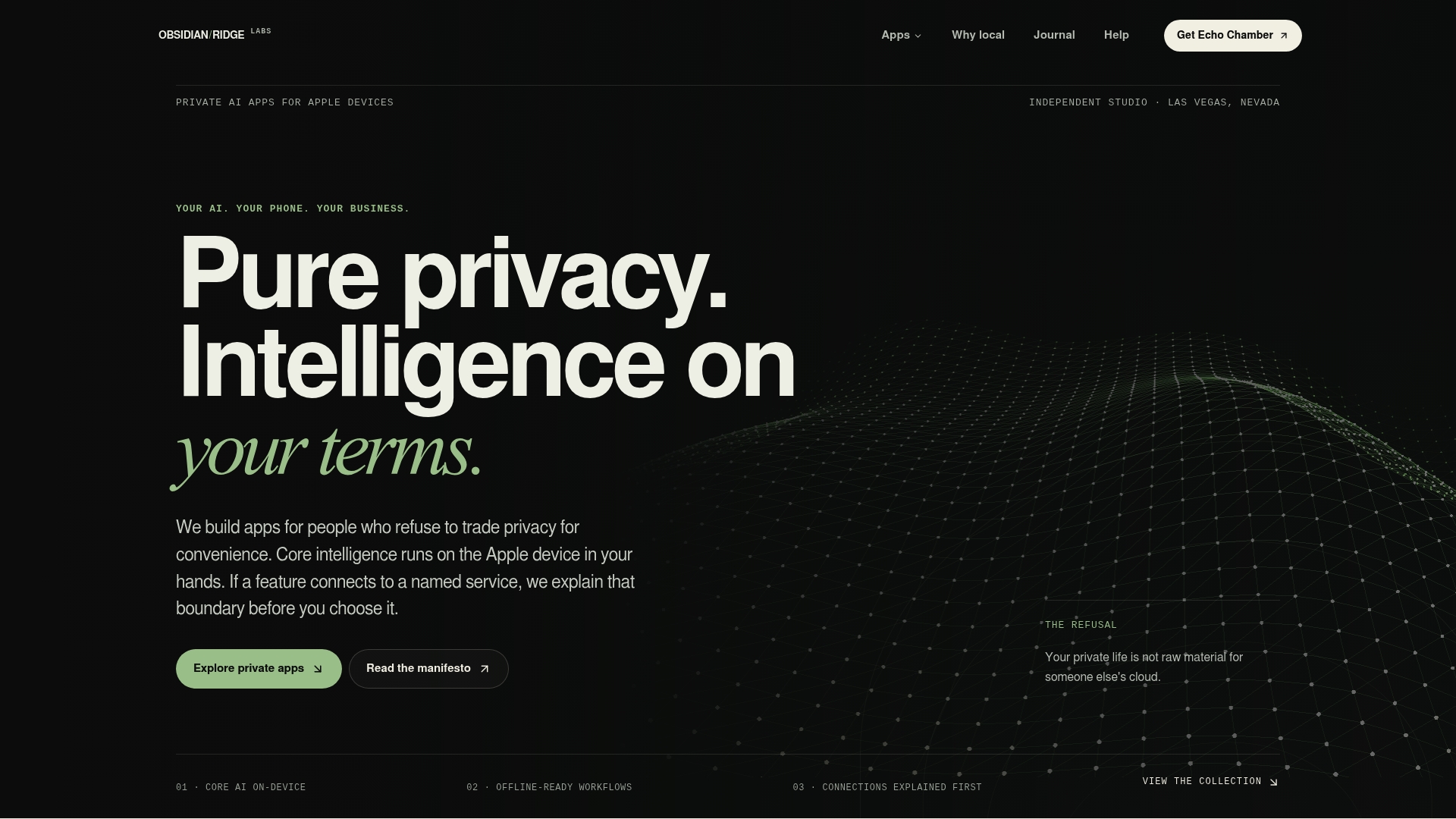
That's the practical distinction worth weighing. Instead of spending time each month re-checking App Privacy Report to confirm an app hasn't started phoning home, you can choose tools designed from the ground up to keep sensitive information on your device. Obsidian Ridge Labs doesn't ask you to take that on faith either. Its privacy verification guide walks through the same App Privacy Report checks covered in this article, applied to its own apps, so you can confirm local processing rather than trust a label.
If you're evaluating options for private note-taking, budgeting, or transcription, start with the Obsidian Ridge Labs product lineup and run the verification steps yourself before you commit.
Authoritative Resources for Verifying App Privacy Claims
These official pages back up the controls and terminology covered throughout this guide:
- Privacy - Control - Apple, covering permission management in Settings.
- About App Privacy Report - Apple Support, for setup and interpretation of the report's four sections.
- User privacy and data use - App Store - Apple Developer, detailing how privacy labels are compiled.
- Protecting app access to user data - Apple Support, on sandboxing and Data Vault protections.
Sources
- Privacy - Control - Apple
- About App Privacy Report - Apple Support
- User privacy and data use - App Store - Apple Developer
- Protecting app access to user data - Apple Support
FAQ
How Do I Stop iPhone Apps From Collecting Data?
Go to Settings > Privacy & Security, revoke permissions apps don't need, then turn off "Allow Apps to Request to Track" under the Tracking menu to block App Tracking Transparency requests across your device.
What Is the Secret iPhone Setting Everyone Should Know?
App Privacy Report, found under Settings > Privacy & Security, is the setting most people never enable, and it's the only built-in tool that shows exactly which domains your apps have contacted and when.
Can You Tell if Someone Is Remotely Accessing Your iPhone?
Check Settings > Privacy & Security for unfamiliar app permissions, review devices signed into your Apple ID, and contact Apple Support directly if you see activity you don't recognize, since remote access typically leaves traces in account and device lists rather than in app permissions alone.
Is It Possible to Clear App Data on iPhone?
Yes. Deleting an app removes its local data, while offloading keeps your documents for a future reinstall; server-side copies of your data may still require a separate deletion request through the developer's privacy policy or support contact.