
Neither tool wins on its own. Notes build the understanding you need on first contact with new material, while flashcards convert the facts worth keeping into durable, long-term memory through spaced retrieval. Most learners get better results from a layered system than from picking a side, and the research on testing and spacing explains why. The sections below walk through the evidence, the rules for each tool, and a workflow you can start using today.
TL;DR:
- Flashcards are most effective for locking in discrete, testable facts like vocabulary, formulas, or dates through active recall and spaced repetition.
- Notes are better suited for building understanding, capturing relationships, and organizing multi-step reasoning, especially in essay-based or reasoning-heavy subjects.
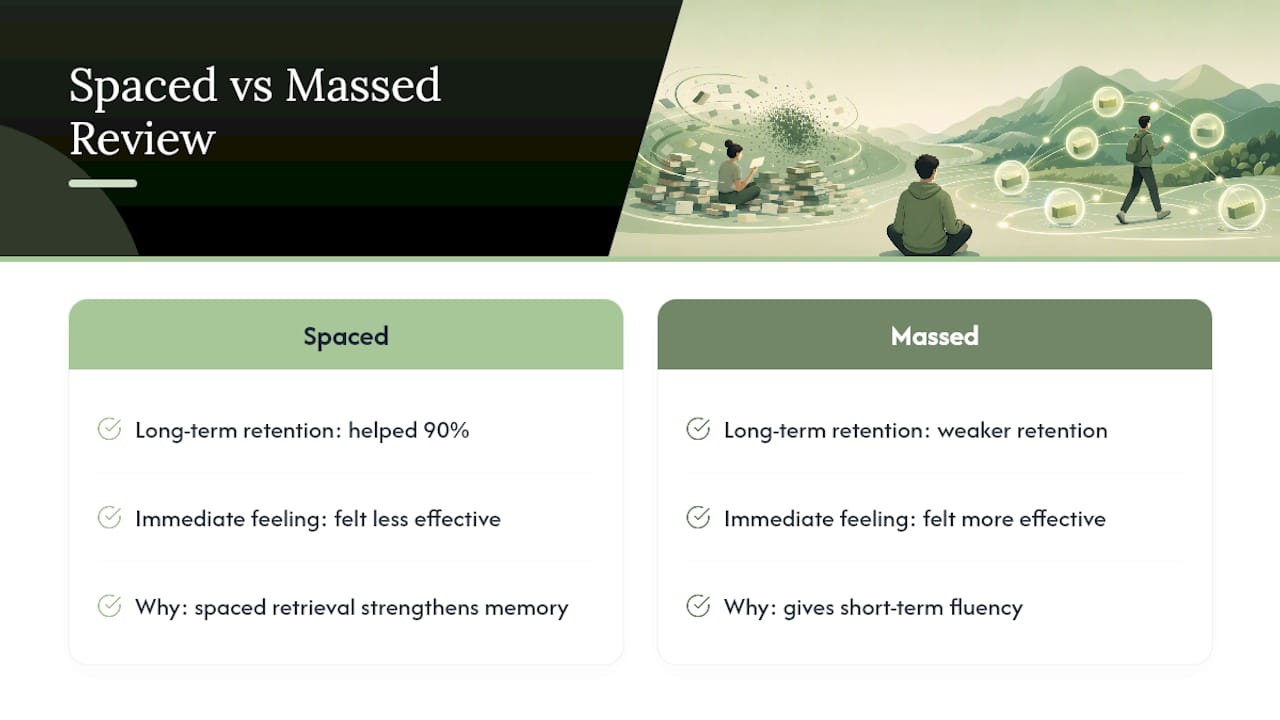
- Spaced review significantly improves retention for flashcards, with research showing it outperforms massed practice in 90% of participants, even if cramming feels more effective initially.
- Creating effective flashcards involves paraphrasing facts, scheduling increasing intervals, and extracting atomic questions from notes to avoid recognition-based testing.
- Combining notes and flashcards in a layered workflow, starting with messy notes and distilling high-value facts into spaced-repetition cards, yields the best long-term learning gains.
Table of Contents
- Flashcards vs Notes: A Quick Comparison
- What Does Cognitive Science Say About Flashcards and Notes?
- When Should You Rely on Flashcards Instead of Notes?
- When Should You Rely on Notes Instead of Flashcards?
- How Do You Combine Notes and Flashcards for Long-Term Retention?
- How Do You Turn a Page of Notes Into Flashcards?
- A Layered System Beats Picking a Side
- Sources
- FAQ
Flashcards vs Notes: A Quick Comparison
Each tool solves a different problem, and confusing the two is the most common study mistake students make.
- Retention of discrete facts: Flashcards win. Active recall and spacing target exactly this job.
- Building comprehension and systems: Notes win. They capture relationships, sequences, and context that a single card can't hold.
- Time investment: Notes take longer to create but less to maintain; flashcards are quick to write but need ongoing review sessions.
- Best subjects for flashcards: vocabulary, formulas, anatomy terms, dates, foreign language conjugations, drug names.
- Best subjects for notes: essay-based humanities, lab procedures, math derivations, anything requiring multi-step reasoning.
If a fact has one correct answer, it belongs on a card eventually. If a topic needs you to trace how ideas connect, it belongs in notes first.
What Does Cognitive Science Say About Flashcards and Notes?
The strongest argument for flashcards isn't tradition. It's the testing effect, one of the most replicated findings in learning science. Practicing retrieval, actually trying to pull an answer from memory, strengthens the memory trace far more than passively rereading the same material, according to research on the testing effect. A separate review of retrieval practice and memory consolidation found the same pattern across dozens of experiments: the act of struggling to recall, even when you get it wrong, does more for long-term memory than a fifth read-through ever will.
Timing matters as much as the act of testing itself. A controlled study on flashcard scheduling found that spacing out review sessions beat cramming the same material into one sitting for 90% of participants, yet most of those same participants believed massed practice felt more effective right after their first study session. That mismatch between what feels productive and what actually works is worth sitting with.
Notes carry their own evidence base, just for a different outcome. Teaching-center guidance from UIC's note-taking research shows that selective, structured note-taking supports conceptual understanding in ways flashcards cannot. Notes require deciding what matters, why it matters, and how it connects to what came before. That decision-making is where comprehension actually forms. Flashcards test what you know. Notes help you figure out what's true in the first place.
When Should You Rely on Flashcards Instead of Notes?
Flashcards earn their place once you already understand the concept and just need it locked in for retrieval on demand. That makes them the right tool for vocabulary lists, chemical formulas, historical dates, anatomical structures, and any late-stage review before an exam.
- Write one idea per card. Two facts on a single card forces you to guess which one is being tested.
- Phrase the front as a genuine question or prompt, not a fragment you can pattern-match.
- Paraphrase into your own words rather than copying the note verbatim. The act of rewording forces the generation effect, a second layer of encoding beyond simple exposure.
- Schedule reviews with increasing intervals instead of drilling the same deck daily. Khan Academy's guide to spaced repetition lays out how the intervals should grow as your accuracy improves.
- Avoid flipping the card the instant you feel unsure. Give yourself a real few seconds to retrieve before checking the answer.
The Learning Scientists recommend going a step further once basics are locked in: pair two related concepts on one card and ask yourself to explain how they differ. That single change pushes flashcard use from rote recall into genuine reasoning.
Pro Tip: If you're building digital decks, an app that runs spaced-repetition scheduling on-device, without sending your study material to a cloud server, keeps sensitive coursework private while still automating the interval math for you.
When Should You Rely on Notes Instead of Flashcards?
Notes do their best work the moment you encounter new material, before you know which facts even matter enough to memorize. They're where you build the mental model, not just store isolated facts.
- Cornell notes: split the page into cues, main notes, and a summary section, ideal for lecture-based courses.
- Concept maps: visualize relationships between ideas, useful for systems-heavy subjects like biology or economics.
- Progressive summarization: highlight your own notes in successive passes, distilling down to the few lines that actually matter.
Handwriting notes, rather than typing verbatim, forces you to compress and paraphrase in real time, which is a form of active learning even before you've opened a single flashcard app, according to note-taking research from UIC. Cornell's Learning Strategies Center recommends structuring notes with clear headers and short cue phrases in the margin specifically because that structure makes later review, and later flashcard creation, dramatically faster. Messy, unstructured notes are hard to mine for cards. Organized ones practically write the cards for you.
How Do You Combine Notes and Flashcards for Long-Term Retention?
The most reliable routine follows three stages, and it works because it matches each stage to the cognitive job it's actually good at.
- Take messy notes during first exposure. Don't worry about polish. Capture everything relevant while the lecture or reading is fresh.
- Distill within 24 hours. Classroom research on note-taking and review behavior found students who don't revisit and organize notes quickly tend to retain only a fraction of what they wrote down. A same-day or next-day pass to underline, summarize, and flag key facts fixes that.
- Convert the highest-value facts into flashcards for spaced review. Not everything deserves a card. Only atomic, testable, high-stakes facts make the cut.
Statistic to remember: in that same controlled flashcard study, spaced review outperformed massed practice for 90% of participants, even though most of them initially judged cramming to feel more effective.
Time allocation depends on the subject. For fact-heavy courses like anatomy or a foreign language, learners may spend a larger portion of study time on flashcard review than on notes. For reasoning-heavy courses like calculus or philosophy, the reverse tends to hold. The point isn't a rigid formula. It's recognizing which cognitive demand the material makes on you.
How Do You Turn a Page of Notes Into Flashcards?
Converting notes into cards is a skill, and most students do it inefficiently by copying entire definitions verbatim, which produces cards that test recognition instead of recall.
- Highlight the note page for anything that's a discrete, testable fact rather than a broader concept.
- Extract each highlighted item onto its own line, separate from the surrounding context.
- Write it as an atomic question and answer, one fact per card.
- Paraphrase instead of copying. Compressing the wording into your own phrasing forces a second pass of encoding before the card ever gets reviewed, according to the Learning Scientists' guidance on flashcards versus notes.
- Tag the card back to the note page or section so you can retrieve fuller context if you get it wrong during review.
Templates help here. A "define" card asks for a term's meaning. An "apply" card gives a scenario and asks for the correct formula or step. A "compare" card names two related concepts and asks for the key difference, which pushes past simple recall.
Keep the note if the material is a process, a proof, or something you'll need to reconstruct step by step. Make a card if it's a fact you'll need to retrieve instantly, with no derivation required.
Pro Tip: Batch your conversion. Check out these AI productivity workflows that save time to automate and streamline note distillation. Do it once per week for accumulated notes instead of after every single class. Batching forces you to be selective, and selectivity is exactly what keeps flashcard decks from becoming bloated and unreviewable.
A Layered System Beats Picking a Side
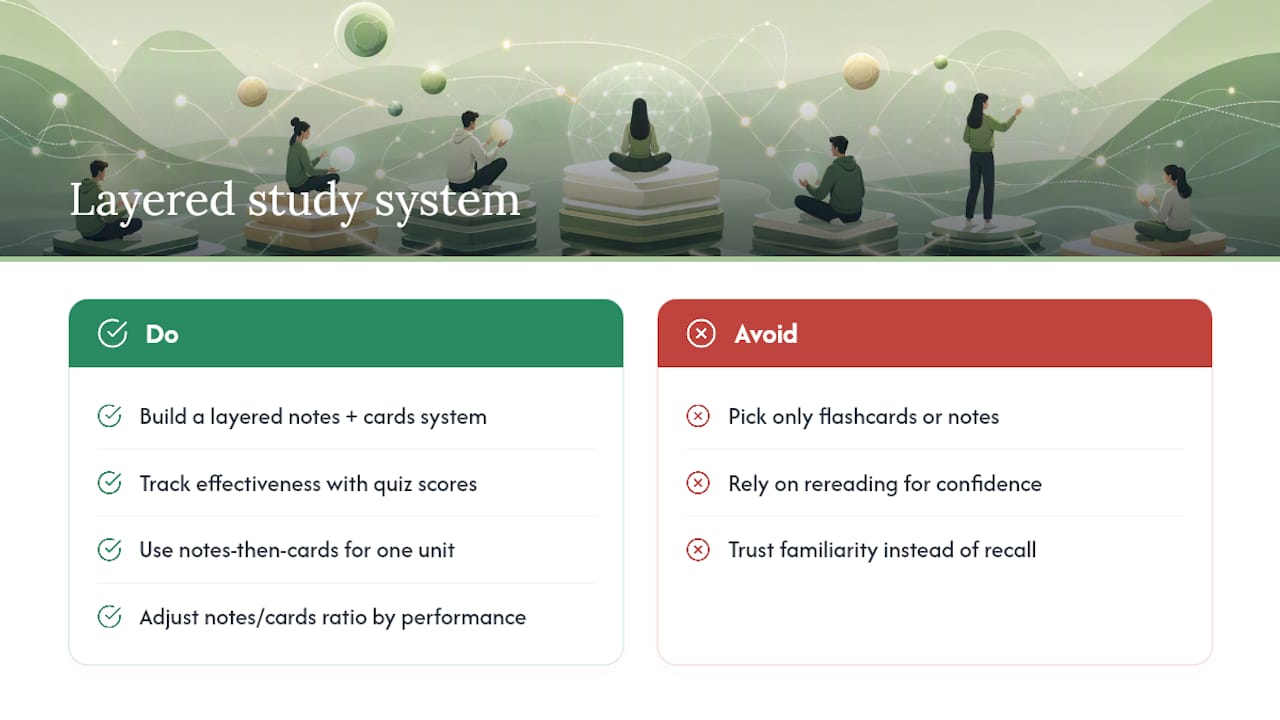
The honest answer to "flashcards or notes" is that the question itself is a false dichotomy. Neat, tidy notes create a comfortable feeling of familiarity that isn't the same as retrieval strength, a trap researchers call the fluency illusion. You can reread a page five times and feel ready, then blank on the exam, because rereading was never the skill being tested.
My honest recommendation: build the layered system described above, and actually track whether it's working through your own quiz scores or recall accuracy, not just how confident you feel. As a company that builds privacy-first, on-device tools for people who take learning seriously, Obsidian Ridge Labs has a direct stake in getting this right. Try the notes-then-cards workflow for one unit, then adjust the ratio based on how the subject actually behaves.
— Alex
Sources
For readers who want the primary sources: the testing effect study and retrieval practice review cover recall; the spacing experiment covers scheduling; Cornell's notes guide and the Learning Scientists blog cover technique.
FAQ
What Are the Disadvantages of Using Flashcards?
Flashcards can encourage rote memorization without real understanding if you copy definitions verbatim instead of paraphrasing, and they're poorly suited to subjects that require multi-step reasoning rather than discrete facts. They also demand ongoing maintenance since spaced review only works if you keep coming back to the deck.
How Should People With ADHD Approach Note-Taking?
Structured formats like Cornell notes or concept maps tend to work better than long-form linear notes because they break information into smaller, visually distinct chunks that are easier to scan and revisit. Pairing short note-taking sessions with immediate, active review, rather than passive rereading later, also helps sustain attention.
How Can I Turn My Notes Into Flashcards?
Highlight testable facts in your notes, extract each one onto its own card as a paraphrased question and answer, and tag it back to the original note section for context. Focus on atomic, high-value facts rather than converting every line, since overloaded decks become unreviewable.
Do Students Still Use Flashcards Today?
Yes. Flashcards remain widely used in 2026, both as physical decks and through digital spaced-repetition apps, precisely because the underlying cognitive science, retrieval practice and spacing, keeps holding up in controlled research. Digital versions add automated scheduling, though on-device apps also address growing concerns about where study data gets stored.