
A true local data only app stores and processes your data exclusively on your device, with no required server-side step at any point in the workflow. Such apps genuinely exist on Apple hardware, but the label demands scrutiny: Apple's own on-device systems can quietly hand off complex requests to Private Cloud Compute, a server-based layer that processes data without retaining it. The honest verdict is that local-only is achievable, but it must be verified feature by feature, not assumed from marketing copy.
TL;DR:
- App Store privacy labels can omit occasional compute paths, so compare each label with the full policy and look for server processing or Private Cloud Compute.
- Run the app’s core feature, then check App Privacy Report for new network domains; repeat with airplane mode and after every app or iOS update.
- Short recordings, journaling, and basic calculations often work locally, but bank links and syncing across devices require servers, while long audio may trigger cloud processing.
- Exclude sensitive apps from iCloud Backup, use a strong passcode, and keep encrypted local exports because device storage cannot protect a stolen, unlocked phone.
Table of Contents
- What "local data only" actually means on Apple devices
- How to verify an app keeps data local
- Security tradeoffs and device hygiene for local data
- What to expect from each local-first app category
- Setting up your device to enforce local-only behavior
- Why on-device-first design is harder than it looks
- A privacy-first option worth trying: Echo Chamber Pro
- FAQ
- Sources
What "local data only" actually means on Apple devices
Apple's platform blurs a distinction that privacy-conscious readers need sharp. On-device processing runs entirely on your iPhone, iPad, or Mac using the device's own chip. Private Cloud Compute is a different thing: it moves select, complex requests to Apple silicon servers, processes them, and deletes the data afterward without retention. Apple documents both behaviors as part of the same Apple Intelligence system, which means a feature can start on-device and finish on a server depending on request complexity.
App Store privacy labels add another layer. Apple's developer guidance treats data as not "collected" when it never leaves the device, so a label showing no data collection can still coexist with occasional server fallbacks for specific features, since the label addresses retention and transmission, not every possible compute path. Reading a privacy policy closely alongside the label is the only way to catch the gap.
Watch for these phrases in a privacy policy, since they usually signal cloud fallback rather than strict local-only behavior:
- "May use server-side processing" for certain requests or file sizes
- "If your device cannot complete this locally"
- Any mention of "Private Cloud Compute" or comparable server infrastructure
- References to "temporary processing" on remote systems, even when framed as privacy-protective
How to verify an app keeps data local
Screening happens in two stages: before you install, and after.
- Read the App Store privacy label and compare it against the app's full privacy policy, not just the summary.
- Search the policy text for explicit "no uploads" or "opt-in only" language regarding network features.
- Check the App Store product page description for any mention of optional cloud features, voice sync, or account creation.
- After installing, enable App Privacy Report in Settings under Privacy & Security.
- Run the app's core feature, such as transcription or journaling, and immediately check the report for new network domains.
- Pay attention to microphone and camera access logs that appear alongside unexpected outbound connections.
- For model-heavy features like long-form audio transcription or image generation, repeat the test with airplane mode on to confirm the feature either completes locally or fails gracefully rather than silently calling out.
Pro Tip: Run the App Privacy Report test again after every app or iOS update, since a feature that was local-only last month can change without notice.
Security tradeoffs and device hygiene for local data
Keeping data on your device removes one entire category of risk: a centralized server breach exposing thousands of users at once. It does not remove device-level risk. A lost, stolen, or compromised phone still exposes everything stored on it, which is why NIST's mobile device security guidance treats privacy as a system problem involving the operating system, the hardware, the app, and user behavior together, not the storage location alone.
Practical steps that follow from that U.S. GPS Tracker Privacy guidance:
- Keep iOS or macOS updated to the current version, since NIST ties OS lifecycle management directly to device security posture.
- Use a strong passcode and biometric lock rather than a short numeric PIN.
- Install apps only from the App Store rather than sideloaded sources, which supports the vetting step NIST recommends.
- Turn off automatic iCloud backup for apps where you want zero cloud copies, since backups are a common unintentional data path.
- Consider an encrypted local export instead of cloud sync when you need a backup copy at all.
Local storage is safer against mass breaches, not against a stolen, unlocked device.
What to expect from each local-first app category
Local-only viability varies a lot by category, and the pattern is fairly consistent across apps we have seen in this space.
- Transcription: short recordings typically process fully on-device; very long audio or high-accuracy modes sometimes route to cloud models for speed.
- Journaling: naturally suited to local-only design, since entries rarely need remote processing beyond optional search indexing.
- Finance management: local calculation is common, but bank-linking features almost always require a server connection by design.
- Coaching and study tools: core logic runs locally; features like generated quizzes or adaptive plans sometimes use cloud inference for larger models.
- Digital wardrobe and home inventory: image storage and tagging are usually local-friendly, with cloud use mostly limited to optional sharing.
Any feature involving multi-device sync or shared access with another person almost always implies a server in the middle, since two devices need a common point of truth. The clearest signal of a well-built local-only app is an explicit local-export option paired with per-feature opt-in toggles for anything that touches a network.
Setting up your device to enforce local-only behavior
Verification is a one-time check. Enforcement is a habit.
- Exclude privacy-sensitive apps from iCloud Backup individually in Settings, under each app's backup toggle, rather than relying on a blanket setting.
- Scope microphone and camera permissions to "while using" rather than "always," and disable Background App Refresh for apps that do not need it.
- Use the app's own local encrypted export feature for backups, then test a restore on a second local device to confirm the backup actually works offline.
- Recheck App Privacy Report after every app update and every iOS update, since permission scopes and network behavior can shift silently with a new release.
Pro Tip: Set a recurring monthly reminder to review App Privacy Report across your privacy-sensitive apps rather than waiting for a specific update to prompt the check.
Why on-device-first design is harder than it looks

The convenient path for any app builder is to lean on cloud inference: it is faster to ship, easier to scale, and cheaper to maintain than optimizing models to run entirely on a phone's chip. On-device-first design means accepting real constraints, smaller models, tighter memory budgets, and more engineering time, in exchange for a guarantee that matters more to some readers than raw feature breadth.
We build Obsidian Ridge Labs around that tradeoff deliberately. Our suite, covering transcription, finance management, and journaling, keeps core processing on the device rather than treating local storage as an afterthought. Where a feature could benefit from a network connection, we treat that as something to disclose and gate behind an opt-in toggle, not something to bury in a privacy policy's fine print. Transparency about what is optional, and what is never sent anywhere, is the standard we hold our own apps to.
— Alex
A privacy-first option worth trying: Echo Chamber Pro
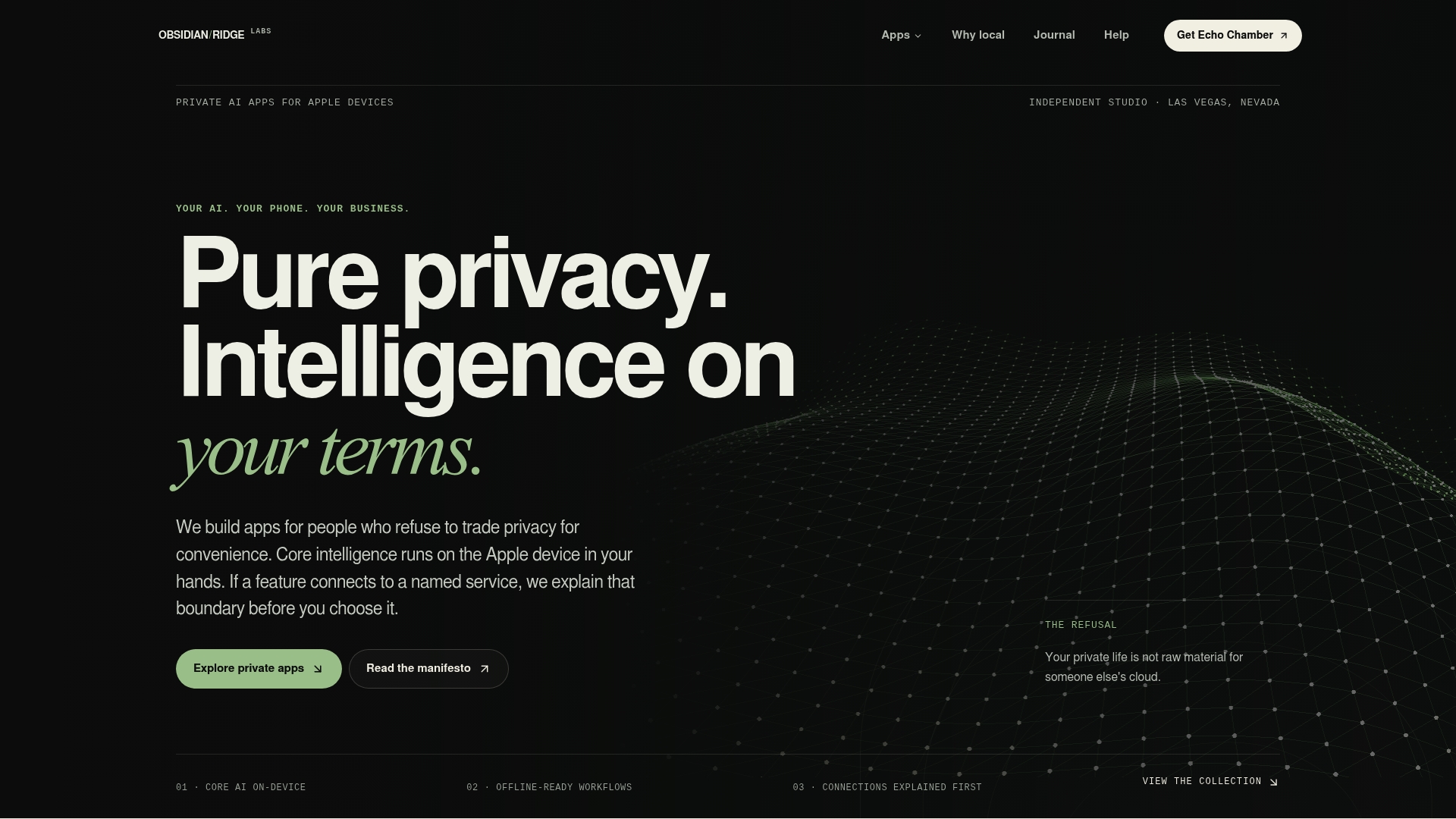
Our app Echo Chamber Pro applies the same on-device standard this article describes: transcription, journaling, and finance management features designed to run locally, with any network feature disclosed and opt-in rather than assumed.
- Core transcription and journaling processing stays on your device by default.
- Finance tracking features avoid sending transaction details to a remote server.
- Any optional connection is explained plainly in the app's privacy policy rather than hidden in broad legal language.
The plan is available with monthly, yearly, or one-time purchase options on the Echo Chamber Pro product page, where you can check current App Store details before buying. If you want a local-first app you can verify yourself using the same App Privacy Report steps covered above, that page is the direct place to start.
FAQ
Do local data only apps really exist on Apple devices?
Yes, genuine local-only apps exist, particularly for journaling, short transcription, and basic finance tracking, where processing fits comfortably on-device. The catch is that you need to verify each feature individually, since Apple's own systems sometimes blend on-device processing with Private Cloud Compute for heavier tasks.
How is Private Cloud Compute different from local-only processing?
Private Cloud Compute runs on Apple's own servers for complex requests and deletes the data afterward rather than retaining it, according to Apple's security documentation. Strictly local-only processing never leaves your device at all, which makes it a stricter privacy standard than PCC's ephemeral server handling.
What's the fastest way to check if an app is sending my data anywhere?
Enable App Privacy Report in Settings, run the app's core feature, and check the report for any new network domains that appear. If a journaling or transcription feature contacts an unfamiliar domain, treat that as a signal to dig into the privacy policy further.
Does using local-only apps mean I don't need to worry about device security?
No. Local storage protects against large-scale server breaches but not against a lost, stolen, or compromised device, a distinction NIST's mobile security guidance treats as central to mobile privacy. Strong passcodes, current software, and careful backup settings matter just as much as where the app stores your data.
Can I trust App Store privacy labels on their own?
They are a solid first screen, since Apple requires developers to disclose data handling practices, but they address data collection and retention rather than every possible compute path a feature might use. Pair the label with a close read of the privacy policy and a post-install check using App Privacy Report for a fuller picture.