
Yes, privacy-first and local-only habit trackers exist for iPhone, and some process every entry entirely on-device. Before trusting any app with your routines, check its App Privacy label on the App Store listing and turn on App Privacy Report to confirm what actually happens after install. If you want a privacy-first option without the research, an on-device app like Obsidian Ridge Labs' Echo Chamber is worth a look.
TL;DR:
- Most privacy-conscious habit trackers either store data locally on the device or use end-to-end encrypted iCloud sync with two-factor authentication enabled.
- Checking the App Privacy label and monitoring network activity via App Privacy Report helps verify actual data practices versus developer claims.
- Limiting permissions for health, location, and motion data reduces unnecessary data exposure, especially before enabling sync features.
- On-device processing eliminates server-side risks and is ideal for users prioritizing strict privacy, though it may limit multi-device continuity.
- Apps like Echo Chamber Pro exemplify privacy-first design, processing data entirely on-device with transparent privacy disclosures and optional network features.
Table of Contents
- 1. A 5-minute checklist to choose a privacy-first iOS habit tracker
- 2. Privacy models explained: local-only, iCloud sync, and server-backed storage
- 3. How to audit an iOS habit-tracker's real behavior
- 4. Configure iCloud, HealthKit, and device settings to limit exposure
- 5. Why on-device processing changes the privacy equation
- 6. Prioritized rules I use for private habit tracking on iPhone
- 7. A transparent option if you want privacy-first tracking today
- FAQ
- Sources
1. A 5-minute checklist to choose a privacy-first iOS habit tracker
Most App Store listings give you enough information to screen an app before you ever create an entry. The work takes a few minutes and avoids a far longer cleanup later.
- Storage model: confirm whether the app works local-only by default, or whether it defaults to iCloud sync or a developer-run server.
- App Privacy label: check which data types are collected and whether that data is linked to your identity or kept separate.
- Account requirement: see if the app forces sign-up with an e-mail or phone number, or lets you use it anonymously on-device.
- Third-party code: scan the privacy policy for analytics SDKs, ad networks, or crash-reporting tools that quietly receive your data.
- Transparency signals: look for open-source code, a published repository, or a small, named development team. Apps built this way tend to be easier to verify and faster to patch.
None of these checks require technical skill. They require reading what is already disclosed, which most people skip.
Pro Tip: If an app's privacy policy is longer than its feature list and still avoids saying where your data lives, treat that as a signal rather than an oversight.
2. Privacy models explained: local-only, iCloud sync, and server-backed storage
Habit trackers generally use one of three storage models, and each carries different privacy consequences.
- Local-only apps never transmit your entries over the network. This is the simplest privacy model: there is no server to breach and no backup to leak, because the data never leaves the device.
- iCloud/CloudKit sync moves entries between your own devices through Apple's infrastructure. Health data synced this way can be end-to-end encrypted, but only when you have two-factor authentication and a device passcode enabled; without both, Health data is encrypted at rest but not end-to-end.
- Developer server sync stores your backups on the company's own infrastructure rather than Apple's. This matters because retention policies, breach exposure, and employee access all depend on that company's practices, not Apple's.
It is worth separating tracking from data collection. Apple's App Tracking Transparency rules require a prompt before an app can track you across other companies' apps and sites, but declining that prompt does not stop the app from collecting data for its own operation. An app can have zero cross-app tracking and still send every habit entry to its own servers. ATT and local-only storage answer different questions, and treating them as interchangeable is a common mistake.
3. How to audit an iOS habit-tracker's real behavior
A listing's privacy label tells you what a developer has declared. A short audit tells you what the app actually does once installed.
- Read before installing. Check the App Store's App Privacy section and skim the linked privacy policy for sync and third-party SDK language.
- Turn on monitoring. Go to Settings, then Privacy & Security, then App Privacy Report, and enable it before or right after installing the app.
- Use the app normally for a few days. This gives App Privacy Report enough activity to show which domains the app contacts and how often.
- Review permissions. Under Settings, then Privacy & Security, check Health, Motion & Fitness, Tracking, and Location for anything the app requested that it does not clearly need.
- Read the network domains. App Privacy Report lists the domains an app has contacted; a habit tracker reaching analytics or ad-network domains alongside its own is worth a second look.
- Decide and act. Revoke permissions that do not match the app's stated function, or uninstall if the network activity contradicts the privacy label.
Apple's own guidance supports this exact sequence: grant minimum permissions, use the app, then consult App Privacy Report before expanding access, rather than approving every onboarding prompt up front.
Following this order catches far more than reading a privacy policy alone, because it compares stated intent against observed behavior on your own device, as explained in this box breathing timer blog featuring practical insights on behavior and habit-building tools.
4. Configure iCloud, HealthKit, and device settings to limit exposure
Once you have chosen an app, a few settings determine how much of your habit data actually leaves the device.
- Enable two-factor authentication and set a device passcode first. Apple's health privacy documentation ties end-to-end encryption for Health data in iCloud directly to these two settings; without them, synced Health data is encrypted but accessible to Apple under certain conditions.
- Restrict HealthKit access by data type. iOS grants read and write permissions separately for each health metric, so give an app access only to the specific categories it needs for habit logging.
- Review Motion & Fitness and Location permissions. Turn these off, or set Location to "while using," unless a specific feature in the app genuinely depends on them.
- Choose your backup path deliberately. If you want a strict single-device privacy boundary, skip iCloud Backup for the app's data, or confirm the app supports a local-only export instead of a cloud archive.
Pro Tip: Enable two-factor authentication before you turn on any iCloud sync feature. Doing it afterward leaves a window where synced Health data sits without end-to-end protection.
These settings trade a small amount of convenience, mainly around multi-device continuity, for a narrower data path. That tradeoff is worth making deliberately rather than by default.
5. Why on-device processing changes the privacy equation
An app that processes data entirely on the device removes an entire category of risk: there is no server-side copy to breach, subpoena, or quietly repurpose. Obsidian Ridge Labs builds its suite of Apple-only apps around exactly this principle, running core AI and data processing locally rather than routing habit entries, journal text, or finance data through remote servers.
That design choice has practical implications:
- Nothing leaves the device unless a network feature is explicitly opt-in and clearly explained, with no hidden transfers.
- There are no advertising profiles or mandatory account requirements tied to the core functionality.
- Focusing exclusively on Apple platforms allows deeper integration with native hardware security than a cross-platform app typically offers.
On-device processing is not always the better fit. Someone who relies on multiple devices throughout the day may still prefer an app with opt-in iCloud sync, accepting the encryption tradeoffs described earlier in exchange for continuity. The choice depends on whether you value a strict single-device boundary or seamless access across an iPhone, iPad, and Mac.
6. Prioritized rules I use for private habit tracking on iPhone
When I set up a new habit tracker, I start with the narrowest possible permissions and add access only once I understand exactly what it unlocks and where that data goes. A habit app rarely needs Location or Motion & Fitness on day one, so I leave both off until a specific feature demands them.

I also give real weight to whether an app lets me stay local-only by choice rather than by accident. Plenty of apps technically support offline use but nudge you toward an account or cloud sync during setup. I look for the ones that make local-only an explicit, respected option rather than a workaround.
Before I enable any sync feature tied to Health data, I confirm two-factor authentication and a device passcode are already active. Skipping that step is the single most common way people end up with Health data that is encrypted but not end-to-end protected, often without realizing it.
— Alex
7. A transparent option if you want privacy-first tracking today
If the checklist above sounds like more diligence than you want to repeat for every new app, an on-device app like Echo Chamber designed for privacy is worth considering. Processing happens on-device, any network feature is opt-in and disclosed rather than buried, and there is no forced account just to log a habit.
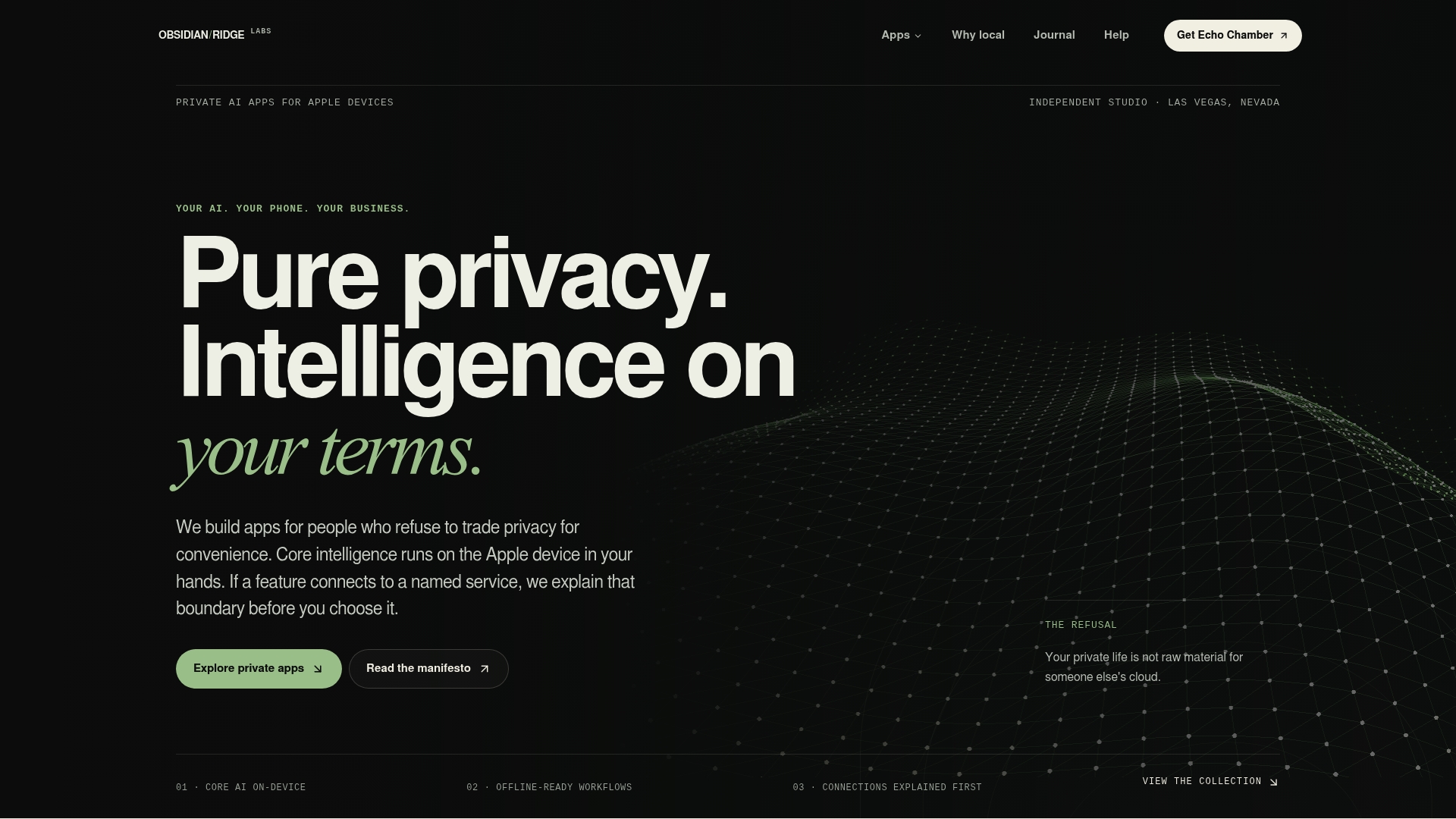
Echo Chamber Pro is available through the App Store as a monthly subscription at $2.99, a yearly subscription at $29.99, or a one-time purchase at $79.99. You can run the same audit described earlier in this article on Echo Chamber Pro itself: check its App Privacy label, enable App Privacy Report, and confirm the network activity matches what it discloses.
FAQ
Is there a built-in habit tracker on iPhone?
iPhone does not ship a dedicated habit tracker, though the Health app lets you log certain wellness metrics and share specific data types with other apps or people under fine-grained controls. For dedicated habit tracking with streaks and custom routines, you need a third-party app from the App Store.
What is the best iOS habit tracker for privacy?
There is no single official ranking, since "best" depends on whether you prioritize strict local-only storage or multi-device sync. Look for an app whose App Privacy label shows minimal data collection, that offers an anonymous or local-only mode, and that discloses any third-party SDKs clearly; Echo Chamber Pro from Obsidian Ridge Labs is one option built around on-device processing.
What are the best habit tracker apps for iPhone?
The strongest options for privacy-conscious users are apps that default to local-only storage, disclose third-party code in their privacy policy, and keep account creation optional rather than mandatory. Checking the App Privacy label and running App Privacy Report after a few days of use is the most reliable way to confirm an app matches its claims.
What is the best app for habit accountability without sacrificing privacy?
An accountability feature, such as reminders or progress sharing, does not require your data to leave the device; look for apps that keep accountability tools local or make any sharing feature explicitly opt-in. Apps that require a server-side account purely to send a local notification are usually adding unnecessary data exposure.
How do I know if a habit tracker's iCloud sync is actually private?
Check whether the app relies on Apple's CloudKit framework and whether your account has two-factor authentication and a device passcode enabled, since Health data sync is only end-to-end encrypted under those conditions. If those settings aren't active, treat synced Health data as encrypted at rest but not fully protected from Apple-side access.