
For a quick decision: try Obsidian Ridge Labs Private Strength Coach if on-device privacy matters to you, Boostcamp if you want named-method programs on a permanent free tier, and Future if you want a real human coach. Each solves a different gap that Fitbod's 2025 price increases made more visible to cost-conscious lifters.
Here is the shortlist with one-line verdicts:
- Obsidian Ridge Labs Private Strength Coach — on-device AI with no cloud data path; Apple-only, subscription or lifetime pricing; best for privacy-first Apple users
- Boostcamp — 11,000+ named-method programs (5/3/1, nSuns, GZCLP) on a permanent free tier; Pro at $59.99/year
- Freeletics — bodyweight and gym AI coaching with nutrition integration; subscription-based, iOS and Android
- Future — live human coach via text and Apple Watch; premium subscription, iOS only
- Trainiac (Wellhub/Trainiac) — structured human-designed programs with coach check-ins; subscription-based, iOS and Android
- SensAI — AI-driven session generation with recovery awareness; subscription-based
- Strong — manual logging with deep volume tracking; free tier plus one-time purchase option
- JEFIT — large community exercise library with social features; free tier plus subscription
- Hevy — clean, fast logging with social workout sharing; free tier plus subscription
Table of Contents
- How do these Fitbod alternatives actually compare?
- What each app actually offers: a closer look
- How do you pick the right app for your training style?
- How do adaptive AI apps perform on messy real days?
- Key Takeaways
- Why the privacy tradeoff in fitness AI deserves more attention
- Obsidianridgelabs Private Strength Coach: all AI, no cloud
- Useful sources and further reading
How do these Fitbod alternatives actually compare?
The columns below reflect the dimensions that most directly affect your daily experience: personalization model, how the app handles a missed session or a hotel gym, privacy posture, and what you pay over time. Read the table as a decision filter, not a ranking.
| App | Best For | Pricing | Platforms | Personalization Model | Messy-Day Adaptability | Privacy / On-Device | Library & Logging | Integrations | Trial / Refund |
|---|---|---|---|---|---|---|---|---|---|
| Obsidian Ridge Labs Private Strength Coach | Privacy-first Apple users | Subscription or lifetime | iOS only | On-device AI, no cloud | Adjusts locally; no telemetry sent | Full on-device processing | RPE, sets, reps, volume | Apple Health, Apple Watch | App Store trial |
| Boostcamp | Named-method block programming | Free tier; Pro $59.99/yr | iOS, Android | Structured named programs | Manual session skip; program stays intact | Cloud sync | 11,000+ programs, RPE support | Apple Health, Google Fit | Free tier permanent |
| Freeletics | Bodyweight + gym AI + nutrition | Subscription | iOS, Android | AI coaching with nutrition | Coach adapts weekly plan | Cloud | Bodyweight, gym, nutrition | Apple Health, Google Fit | Trial available |
| Future | Human-coached accountability | Premium subscription | iOS | Human coach via text | Coach reschedules manually | Cloud | Coach-set workouts | Apple Watch, Apple Health | 1-week trial |
| Trainiac | Structured programs + check-ins | Subscription | iOS, Android | Human-designed programs | Coach check-ins | Cloud | Structured sets/reps | Apple Health | Trial available |
| SensAI | AI session generation + recovery | Subscription | iOS, Android | AI per-session generation | Recovery-aware AI | Cloud | RPE, volume | Apple Health | Trial available |
| Strong | Manual logging, volume tracking | Free + one-time purchase | iOS, Android | Manual / template-based | User-controlled | Cloud optional | Deep volume, RPE, RIR | Apple Health, Apple Watch | Free tier permanent |
| JEFIT | Community + large exercise library | Free + subscription | iOS, Android | Community programs + manual | Manual | Cloud | 1,300+ exercises, sets/reps | Apple Health, Google Fit | Free tier permanent |
| Hevy | Fast logging + social sharing | Free + subscription | iOS, Android | Manual + social routines | User-controlled | Cloud | Sets, reps, volume | Apple Health | Free tier permanent |
| Fitbod (reference) | AI session generation | Subscription (raised 2025) | iOS, Android | AI per-session | Equipment-aware AI | Cloud | RPE, sets, reps | Apple Health, Apple Watch | 3-session free trial |
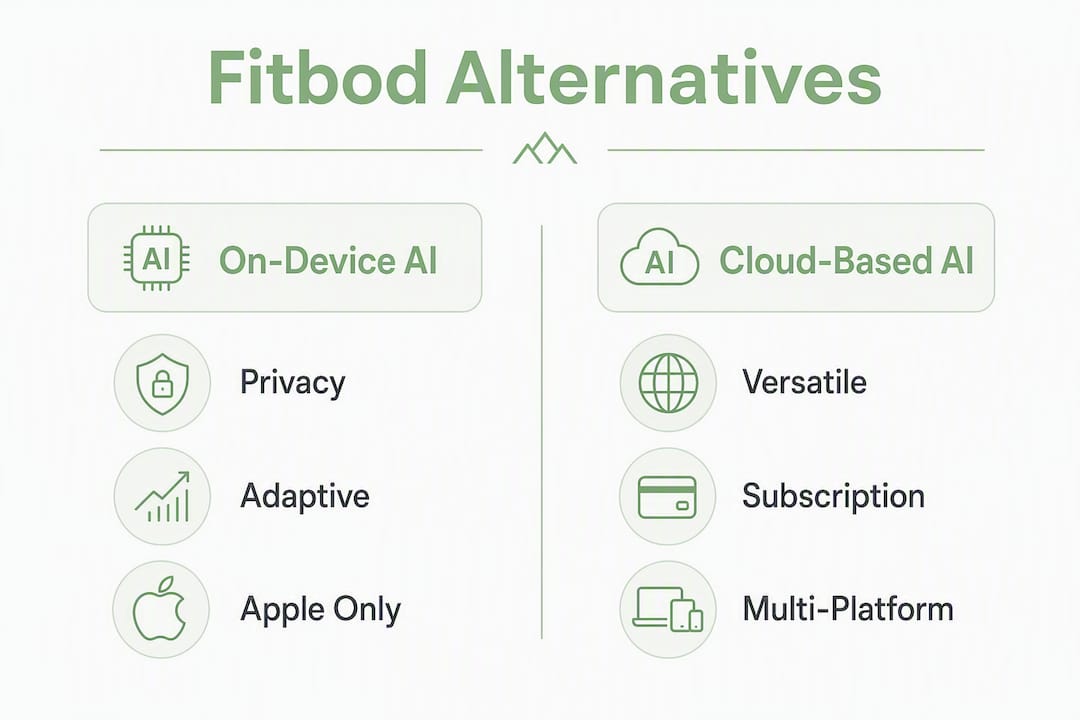
Pricing notes: Lifetime purchase options in this category often cost enough to be economically comparable to a few years of subscription fees, effectively removing ongoing subscription costs. Strong and Obsidian Ridge Labs Private Strength Coach both offer one-time purchase paths. Boostcamp offers a free tier that provides access to structured programming without cost. Fitbod's subscription-only model, following its 2025 price increase, is the primary reason many lifters are re-evaluating the category.
How to read this table: Focus first on the "Personalization Model" and "Messy-Day Adaptability" columns. An app that handles a missed session gracefully tells you more about its coaching quality than its exercise library size does. Then check "Privacy / On-Device" if your health data posture matters, and "Integrations" if you rely on Apple Watch or Strava for logging.
What each app actually offers: a closer look
Obsidian Ridge Labs Private Strength Coach
The only app in this list that performs all core AI processing locally on your Apple device, with no health data sent to a cloud server. The coaching logic runs on-device, which means your training history, recovery notes, and progression data stay on your phone or watch.
- Pros: Full on-device AI; Apple Watch native sync with low latency; subscription or lifetime purchase option
- Cons: Apple devices only; no Android support; smaller community than cloud-first apps
- Best for: Privacy-conscious Apple users who want AI-driven strength coaching without a cloud data path
- Pricing: Subscription or lifetime via App Store
- Platforms: iOS; Apple Watch integration
Boostcamp
Boostcamp's core value is its library of named-method programs: 5/3/1, nSuns, Reddit PPL, GZCLP, Sheiko, and hundreds more. The free tier is permanent and includes the full workout tracker. Boostcamp Pro adds Strength Score and personalized programs for $59.99/year. Lifters who want clear block-based progression with established methodologies often find this more predictable than per-session algorithmic generation.
- Pros: Permanent free tier; 11,000+ programs; strong community validation of named methods
- Cons: Less real-time AI adaptation than algorithm-first apps; nutrition not included
- Best for: Strength lifters who want proven block programming (5/3/1, GZCLP) with no subscription required
- Pricing: Free; Pro $59.99/year
- Platforms: iOS, Android; Apple Health, Google Fit
Freeletics
Freeletics combines AI coaching with bodyweight and gym workouts, and notably includes nutrition guidance in the same interface. This addresses the "nutrition gap" that affects compliance when training and macro-tracking live in separate apps. The AI coach adapts the weekly plan based on logged performance and feedback.
- Pros: Nutrition integration; AI adapts weekly structure; large exercise variety
- Cons: Subscription required for full AI features; less depth for pure strength programming
- Best for: Users who want a combined training and nutrition AI coach on a single platform
- Pricing: Subscription; trial available
- Platforms: iOS, Android; Apple Health, Google Fit
Future
Future pairs you with a real human coach who communicates via text and monitors your Apple Watch data. The coach sets your workouts, adjusts them when you miss a session, and checks in regularly. It is the most hands-on option in this list and the most expensive.
- Pros: Real human accountability; coach-driven rescheduling; Apple Watch monitoring
- Cons: Premium price point; iOS only; coach quality varies
- Best for: Lifters who want human accountability and are willing to pay for it
- Pricing: Premium monthly subscription
- Platforms: iOS; Apple Watch, Apple Health
Trainiac (Wellhub/Trainiac)
Trainiac delivers human-designed structured programs with periodic coach check-ins. It sits between a fully automated AI app and a live coaching service. Programs are structured in multi-week blocks, and coaches review progress at set intervals rather than in real time.
- Pros: Structured block programs; coach check-ins for accountability; iOS and Android
- Cons: Less real-time adaptation than AI-first apps; check-in frequency varies by tier
- Best for: Users who want structured programming with occasional human oversight
- Pricing: Subscription; trial available
- Platforms: iOS, Android; Apple Health
SensAI
SensAI focuses on AI-driven per-session generation with recovery awareness built into the session logic. It tracks recovery signals and adjusts session intensity accordingly, which makes it a closer functional match to Fitbod's core model while adding recovery-layer inputs.
- Pros: Recovery-aware AI; per-session adaptation; RPE and volume logging
- Cons: Cloud-based; subscription required; smaller user base than established apps
- Best for: Lifters who want Fitbod-style AI generation with stronger recovery signal integration
- Pricing: Subscription; trial available
- Platforms: iOS, Android; Apple Health
Strong
Strong is a manual logging app with deep volume tracking, RPE and RIR support, and a one-time purchase option. It does not generate workouts algorithmically. You build your own templates, and the app tracks progression over time with detailed analytics. The free tier and one-time purchase path make it a strong choice for lifters who dislike subscription models.
- Pros: Deep logging (RPE, RIR, volume); one-time purchase available; Apple Watch support
- Cons: No AI session generation; requires self-programming knowledge
- Best for: Experienced lifters who self-program and want the best logging tool available
- Pricing: Free tier; one-time purchase for full features
- Platforms: iOS, Android; Apple Health, Apple Watch
JEFIT
JEFIT's main differentiator is its community exercise library, which exceeds 1,300 exercises with video demonstrations, and its social features including workout sharing and challenges. The free tier is permanent. It is less focused on AI adaptation and more on community-validated programming and tracking.
- Pros: Large exercise library; social challenges; permanent free tier
- Cons: AI personalization is limited compared with algorithm-first apps; interface feels dated
- Best for: Lifters who want community accountability and a large exercise reference library
- Pricing: Free; subscription for advanced analytics
- Platforms: iOS, Android; Apple Health, Google Fit
Hevy
Hevy prioritizes speed and simplicity. Logging a set takes seconds, and the social feed lets you share workouts and follow other lifters' routines. The free tier is permanent and covers most logging needs. It lacks AI session generation but excels at reducing friction in daily logging.
- Pros: Fast logging UX; social workout sharing; permanent free tier
- Cons: No AI session generation; limited periodization tools
- Best for: Lifters who want the fastest possible logging experience with a social layer
- Pricing: Free; subscription for advanced features
- Platforms: iOS, Android; Apple Health
How do you pick the right app for your training style?
The most important decision is training model match, not feature count. Choose by whether you want AI-generated sessions, a named-method block program, or a human coach. Then check ecosystem fit: if you train with an Apple Watch, native watch integration and on-device processing materially reduce daily logging friction compared with cloud-first sync models.
Evaluation checklist:
- Goal alignment — does the app support your primary goal (strength, hypertrophy, fat loss, general fitness)?
- Equipment handling — does it adapt when you switch from a full gym to a hotel gym or home setup?
- Progression logic — does it use block periodization, per-session AI, or manual templates?
- Logging depth — does it support RPE, RIR, and volume tracking, or only sets and reps?
- Nutrition integration — does it include macro tracking, or will you need a separate app?
- Privacy posture — does it process data on-device, or does it require cloud sync? Can you verify on-device claims?
- Platform fit — iOS only, Android only, or cross-platform?
- Cost structure — monthly, annual, or lifetime? Is there a permanent free tier?
Questions to ask during a trial:
- Does the app adjust the next session after a missed workout, or does it simply skip forward?
- Does it factor in sleep or recovery data, or only logged performance?
- Does it sync with Apple Health or Google Fit without requiring a third-party export?
- Can you change equipment mid-program without restarting from scratch?
- Is the progression logic explained, or is it a black box?
- Does the app offer a lifetime purchase, and what features does it include?
Red flags to watch for:
- No recovery metrics or sleep integration in an app that claims adaptive AI
- Opaque personalization with no explanation of why a session was generated
- Forced export to a third-party service to access your own training history
- No trial period or lifetime option alongside a subscription-only model
- Pricing pages that do not show a clear annual vs monthly comparison
Pricing expectations: At monthly rates, most subscription apps cost $10–$20/month. At annual rates, the effective monthly cost drops to roughly $5–$8. A lifetime purchase at $70–$100 breaks even against an annual subscription in one to two years. Over three years, a lifetime option typically costs less than two annual subscriptions combined.
How do adaptive AI apps perform on messy real days?
Recent editorial analysis in 2026 draws a clear line between apps that "select exercises" and apps that provide "coaching quality" under real-world constraints. The distinction matters most when your training week does not go as planned.
"The most effective apps in 2026 treat missed sessions, poor sleep, and travel as coaching signals rather than noise. The question is no longer whether an app can generate a workout, but whether it can adjust the plan's macro structure when life intervenes."
| Scenario | AI Per-Session (Fitbod, SensAI) | Named-Method Block (Boostcamp, Strong) | Human Coach (Future, Trainiac) |
|---|---|---|---|
| Missed session | Regenerates next session; may not adjust macro block | Program advances or holds; user decides | Coach reschedules manually |
| Travel / hotel gym | Equipment-aware session swap | User selects alternate program or modifies | Coach adjusts workout to available equipment |
| Poor sleep / low recovery | Recovery-aware apps (SensAI) adjust intensity; others may not | No automatic adjustment; user modifies manually | Coach factors in reported recovery |
| Equipment loss | Regenerates with available equipment inputs | User switches program; library covers bodyweight | Coach redesigns session |
The practical takeaways from this scenario analysis:
- AI per-session apps handle equipment variation well but vary significantly in how they handle recovery signals. SensAI explicitly incorporates recovery data; Fitbod's model is primarily equipment and muscle-recovery based.
- Named-method block programs (Boostcamp, Strong) do not auto-adapt, but their transparency is an advantage: you know exactly why the program is structured the way it is, which makes troubleshooting easier when progress stalls.
- Human coaches (Future, Trainiac) offer the most flexible real-world adaptation but at the highest cost and with response-time latency.
- On-device AI (Obsidian Ridge Labs Private Strength Coach) handles adaptation locally, which means no telemetry is sent to a cloud server during the adjustment process. For users who log recovery notes or health data, this is a material privacy difference.
App Store ratings as of early 2026 reflect these tradeoffs: apps with strong human coaching components (Future) tend to receive high satisfaction scores from users who complete onboarding, while AI-only apps receive more mixed reviews when users hit the progression ceiling that algorithmic daily generation can produce by prioritizing variety over block-based overload.
Key Takeaways
The strongest Fitbod alternatives in 2026 separate into three clear models: on-device AI for privacy, named-method programs for structured progression, and human coaching for real-world accountability.
| Point | Details |
|---|---|
| Training model match first | Choose AI per-session, named-method block, or human coach before comparing any other feature. |
| Named-method programs for long-term gains | Boostcamp's free tier covers popular named-method programs such as 5/3/1, GZCLP, and nSuns without cost. |
| Lifetime options save money | A $70–$100 lifetime purchase breaks even against annual subscriptions within one to two years. |
| Messy-day adaptability varies widely | Only recovery-aware AI apps and human coaches adjust macro structure, not just session exercises. |
| Obsidianridgelabs for privacy-first Apple users | Private Strength Coach runs all AI locally, with no cloud data path and native Apple Watch support. |
Why the privacy tradeoff in fitness AI deserves more attention
Most fitness app comparisons focus on exercise libraries, pricing tiers, and UI design. The privacy dimension gets a footnote, if it appears at all. That framing misses something material for a specific type of user: someone who logs recovery notes, sleep quality, body weight, and health metrics alongside their training data.

When all of that data lives in a cloud-first app, the data path is real. Your training history, body composition trends, and recovery patterns are on a server you do not control. For many users, that tradeoff is acceptable. For others, particularly those who also use Apple Health as a central health record, it is not a minor consideration.
On-device processing changes the data path entirely. The AI coaching logic runs on your device, the training history stays local, and the Apple Watch sync happens over your local network rather than through a cloud intermediary. Low-latency local processing also has a practical UX benefit: logging a set on your watch does not depend on a network connection, which matters in gyms with poor signal.
The deeper point is that privacy and coaching quality are not in opposition. An on-device model can deliver adaptive session generation, progressive overload logic, and recovery-aware adjustments without sending a single data point to a remote server. The tradeoff is platform scope: on-device AI at this level currently requires Apple's hardware and software stack. That is a real constraint, and it is worth naming clearly.
Pro Tip: Before committing to any fitness app, open your iPhone's Privacy settings, check the app's declared data use under App Privacy Report, and audit which categories of Apple Health data it has requested. An app that requests full Health access when it only needs workout data is a signal worth investigating.
Obsidianridgelabs Private Strength Coach: all AI, no cloud
Your training data is detailed and personal. Obsidianridgelabs builds its Private Strength Coach to keep every bit of it on your device, with no cloud sync required for the AI to function. The coaching logic, your progression history, and your recovery inputs all process locally, which means no data leaves your phone unless you choose to export it.

For Apple users who have already decided they want on-device AI, the practical benefits are concrete:
- No cloud telemetry: training history, body metrics, and recovery notes stay on-device
- Native Apple Watch sync: low-latency logging directly from your wrist, no network dependency
- Subscription or lifetime pricing: one-time purchase available through the App Store, no forced annual renewal
The app is available exclusively for Apple devices. If you train on Android, this is not the right fit. If you are on iPhone or Apple Watch and want strength coaching that does not require a cloud account, explore Obsidianridgelabs Private Strength Coach on the product page, or review the full comparison against Fitbod, Boostcamp, and Hevy to see how the on-device model holds up against cloud-first alternatives.
Useful sources and further reading
Pricing and trial policies change. Verify dates before purchasing.
- Subrupt: Best Fitbod Alternatives (2026) — Editorial roundup covering pricing changes, lifetime options ($70–$100 range), and adaptability metrics.
- TrySoma: Fitbod Alternative Blog (2026) — Commentary on the shift from exercise selection to coaching-quality adaptation; covers the nutrition gap and recovery signal integration.
- GymBird: Alternatives to Fitbod — Broad overview of Fitbod rivals with user-facing feature summaries and trial availability notes.
- Garage Gym Reviews: Best Workout Apps (2026) — Expert-tested rankings across categories including best overall, best for strength, and best personal training app.
- Forbes Health: Best Fitness Apps (2026) — Broad editorial roundup including Apple Fitness+, Nike Training Club, and Peloton App ONE for users whose needs extend beyond strength training.
- Obsidianridgelabs: On-Device AI Privacy Verification Guide — Practical steps for Apple users to audit health sync settings, verify on-device processing claims, and check Apple Watch integration depth.
- Obsidianridgelabs: Best Progressive Overload Apps (2026) — Comparison of apps that implement progressive overload, with analysis of block-based vs per-session progression models.