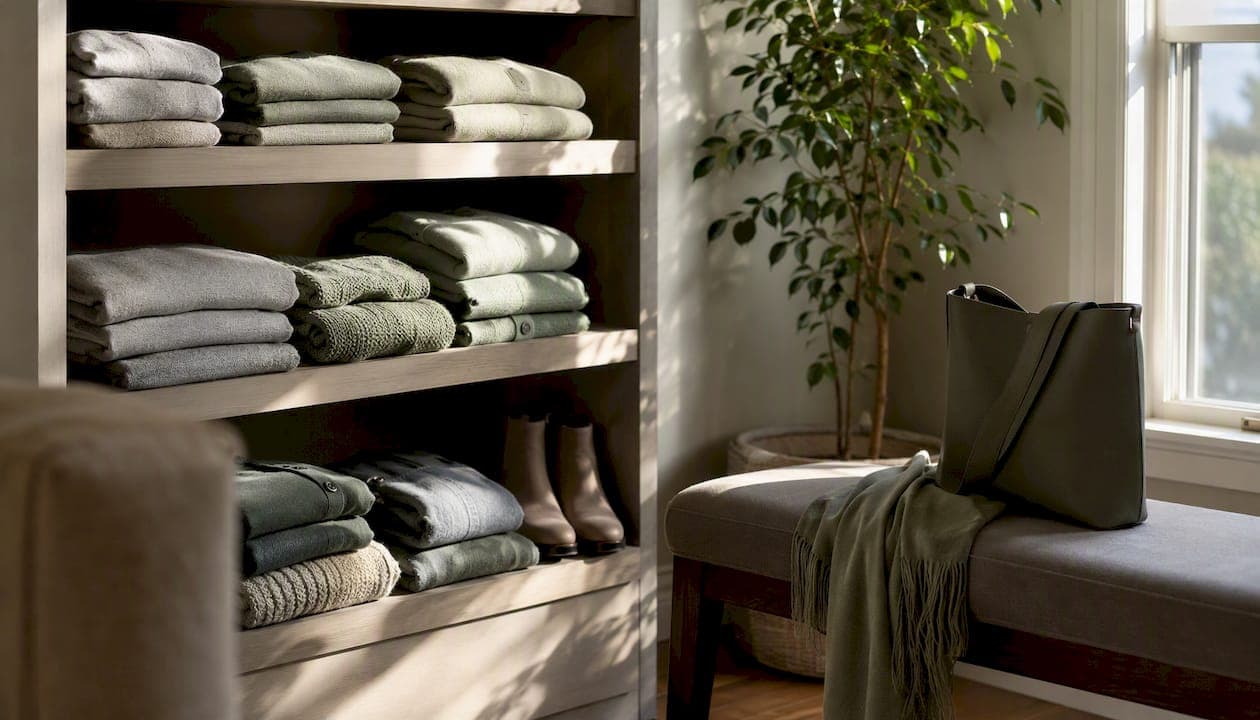
A capsule wardrobe is a small, intentional collection of versatile pieces that mix and match to produce far more outfits than their count suggests. The core benefit is practical: fewer decisions each morning, less money spent on clothes you rarely touch, and a closet that actually reflects how you live.
You can start in 15–30 minutes with three steps:
- Audit: Pull everything out of your closet. Set aside anything you haven't worn in the past year, anything that doesn't fit, and anything damaged beyond easy repair.
- Choose anchors and a palette: Pick 5–8 pieces you already reach for constantly. Note the colors they share. That overlap is your palette.
- Hide the rest and live in the capsule: Box up what you set aside. Don't donate yet. Wear only what remains for 30 days and observe what you actually miss.
That triage takes one focused session. The rest of this guide walks you through each step in depth.
Key Takeaways
A capsule wardrobe works because intentional combinations, not item count, determine how much you can do with what you own.
| Point | Details |
|---|---|
| Start with the audit | A single audit pass typically removes 40–60% of items; the one-year unworn rule is the most reliable filter. |
| Use the pairs-with-three rule | Every new piece should work with at least three items already in your capsule before you buy it. |
| Test for 30–90 days | Live in the capsule before making permanent changes; wear data collected over weeks is more reliable than first impressions. |
| Document outfits with photos | Photographing 10–15 go-to combinations reveals what you actually wear and makes daily dressing faster. |
| Protect your wardrobe data | Obsidianridgelabs' Wove app processes all wardrobe photos and outfit data on-device, with no cloud upload required. |
Table of Contents
- What is a capsule wardrobe, and why does it work?
- How many pieces should your capsule contain?
- Step 1: How to audit your closet honestly
- Step 2: How to choose your core pieces by category
- Step 3: Build outfit formulas and document them
- Step 4: Live in the capsule for 30–90 days and refine
- Rules, systems, and how to adapt them to your life
- What to do with items you remove from your closet
- How a privacy-first digital wardrobe app supports your capsule
- What building a capsule actually teaches you
- Wove keeps your capsule organized without sharing your data
- Sources
What is a capsule wardrobe, and why does it work?
A capsule wardrobe is a small, hard-working collection of items that mix and match to create more outfits than you'd expect — its success depends on intentional combinations, not a prescribed item count or a specific visual aesthetic.
Fashion strategists frame it as a functional management system. The goal is to reduce decision fatigue and cut financial waste from clothing that sits unworn, not to impose a particular look on your life. You can build a capsule around bold color and pattern, or around neutral basics. Both work.
Three benefits show up consistently for people who commit to the system:
- Time savings. When every item pairs with most others, getting dressed becomes a short, low-friction task.
- Spending clarity. A defined wardrobe makes gaps obvious and impulse purchases harder to justify.
- Outfit cohesion. A shared palette and consistent fit level mean pieces look intentional together, even on rushed mornings.
A few myths worth clearing up before you start. A capsule wardrobe is not inherently minimalist. Thirty-three pieces is a popular benchmark, but it is not a rule. You do not have to throw anything out immediately. And it does not require a single aesthetic: a creative professional's capsule and a corporate attorney's capsule will look nothing alike, and both are valid.
How many pieces should your capsule contain?
The honest answer: it depends on your lifestyle. Several well-tested formulas exist, and each fits a different set of constraints.
| Formula | Item Count | Best For | Tradeoffs |
|---|---|---|---|
| Project 333 | 33 items / 3 months | People who want firm limits and fast clarity | Tight for varied dress codes; excludes workout gear |
| 10-Item Capsule | 10 core pieces | Frequent travelers, very consistent lifestyles | Requires high-quality, highly versatile pieces |
| 30–40 Seasonal Capsule | 30–40 per season | Most people with moderate lifestyle variety | Needs seasonal storage and rotation discipline |
| 5-4-3-2-1 Packing Method | ~15 pieces | Travel capsules or weekend trips | Too compact for full-time daily use |
| Modular Capsule | Variable by module | Mixed work/casual/active lifestyles | Requires more planning upfront |
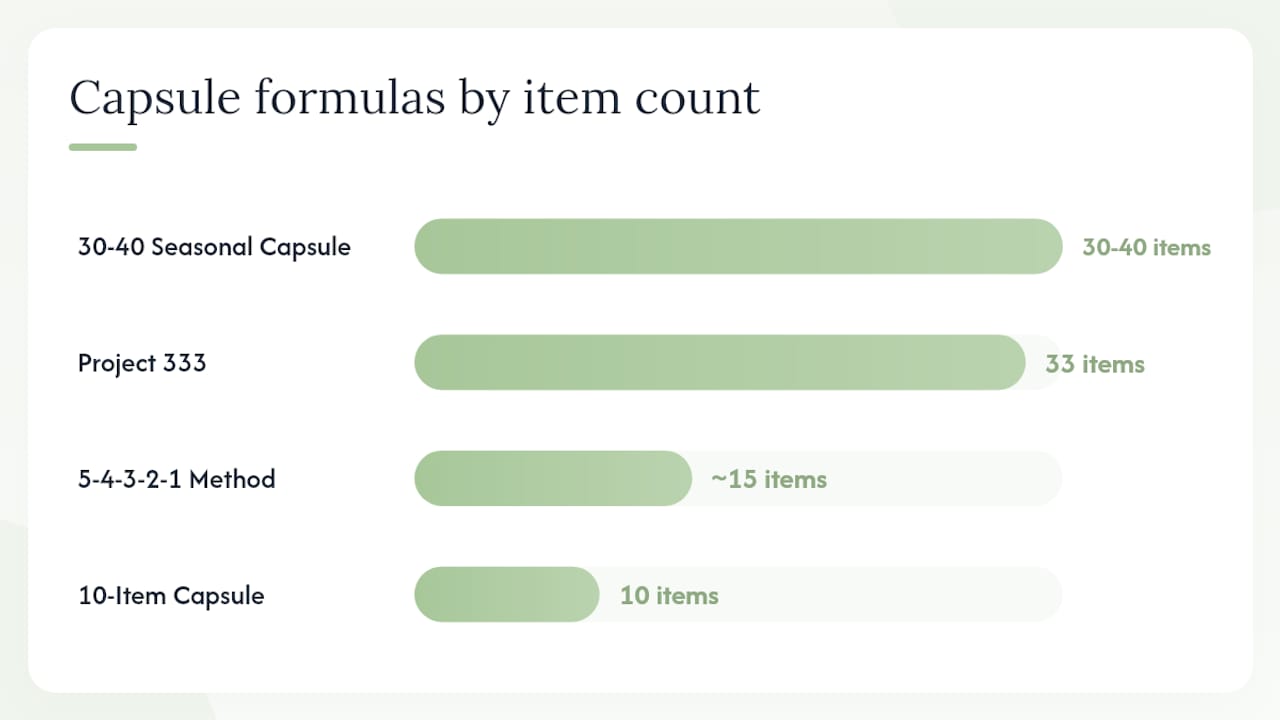
Project 333 is an effective forcing function. Choosing 33 items — clothes, accessories, and shoes — for three months, while hiding everything else, exposes real wardrobe needs quickly. It excludes underwear, sleepwear, and workout-only items, so the count is more manageable than it first sounds.
The 30–40 seasonal capsule suits most beginners. It gives enough range for weather shifts and varied occasions without demanding the discipline that a 10-item system requires.
The 5-4-3-2-1 method assigns category counts: five tops, four bottoms, three shoes, two dresses or layering pieces, one jacket. It was designed for carry-on travel but translates well to a compact everyday capsule for people with simple, consistent routines.
Choose your formula based on three variables: how many distinct dress codes your week contains, how often you do laundry, and how variable your climate is. A remote worker in San Diego with weekly laundry can run a tighter capsule than a consultant in Chicago who travels three days a week and needs business formal on short notice.
Step 1: How to audit your closet honestly
A thorough audit is the foundation. Practical audits commonly eliminate 40–60% of items in one pass, and the one-year unworn rule is a reliable filter: if you haven't worn it in twelve months, you almost certainly won't.
Work through your closet in this sequence:
- Empty the space completely. Pull every item out and lay it flat or hang it in a separate area. Seeing everything at once prevents the "out of sight, out of mind" bias that keeps clutter in place.
- Handle each piece physically. Does it fit well right now, not in theory? Is it damaged, pilled, or stained? A quick physical check is more honest than a visual scan.
- Apply the one-year rule. If you haven't worn it in the past twelve months, set it in the "remove" pile unless there is a specific, concrete occasion coming up.
- Check versatility. Does this item pair with at least three other pieces already in your keep pile? If not, it may be a one-off buy that doesn't earn its space.
- Flag sentimental exceptions deliberately. A few items carry genuine emotional weight. Keep them, but keep them consciously and separately from your active capsule.
- Map your lifestyle proportions. Before finalizing, write down a rough weekly breakdown: how many days are office or client-facing, how many are casual or at-home, how many involve physical activity. Your capsule should mirror that ratio.
A note of caution: don't purge favorites too quickly. If you love a piece but haven't worn it recently, ask why. Sometimes the answer is a fit issue or a missing pairing partner, not a genuine dislike. Box it rather than donate it until you've lived in the capsule for at least 30 days.
Step 2: How to choose your core pieces by category
Once the audit is complete, translate your keep pile into a structured capsule. The Wear-First Method builds the capsule around pieces you already wear most, then fills gaps — reducing waste and producing a capsule that reflects your actual life rather than an aspirational one.
Suggested category counts for a 30–37 piece capsule
- Tops: 8–10 (mix of casual tees, button-downs, blouses, and one or two elevated knits)
- Bottoms: 4–6 (two pairs of pants or trousers, one or two jeans, one skirt or shorts depending on climate)
- Layers and outerwear: 3–5 (one structured blazer or jacket, one casual layer, one weather-appropriate coat)
- Dresses or jumpsuits: 2–3 (one casual, one that can dress up)
- Shoes: 3–4 (one everyday casual, one work-appropriate, one athletic or utility, one occasion shoe)
- Accessories: 3–5 (belt, two bags, two to three jewelry or scarf pieces)
Four sample capsule lists by lifestyle
Office professional (35 pieces): Tailored trousers in navy and charcoal, a pencil skirt, five blouses in white/cream/soft blue, two blazers, a sheath dress, a structured tote, loafers, block-heel pumps, a trench coat, and a handful of simple jewelry pieces. Nearly every top pairs with every bottom.
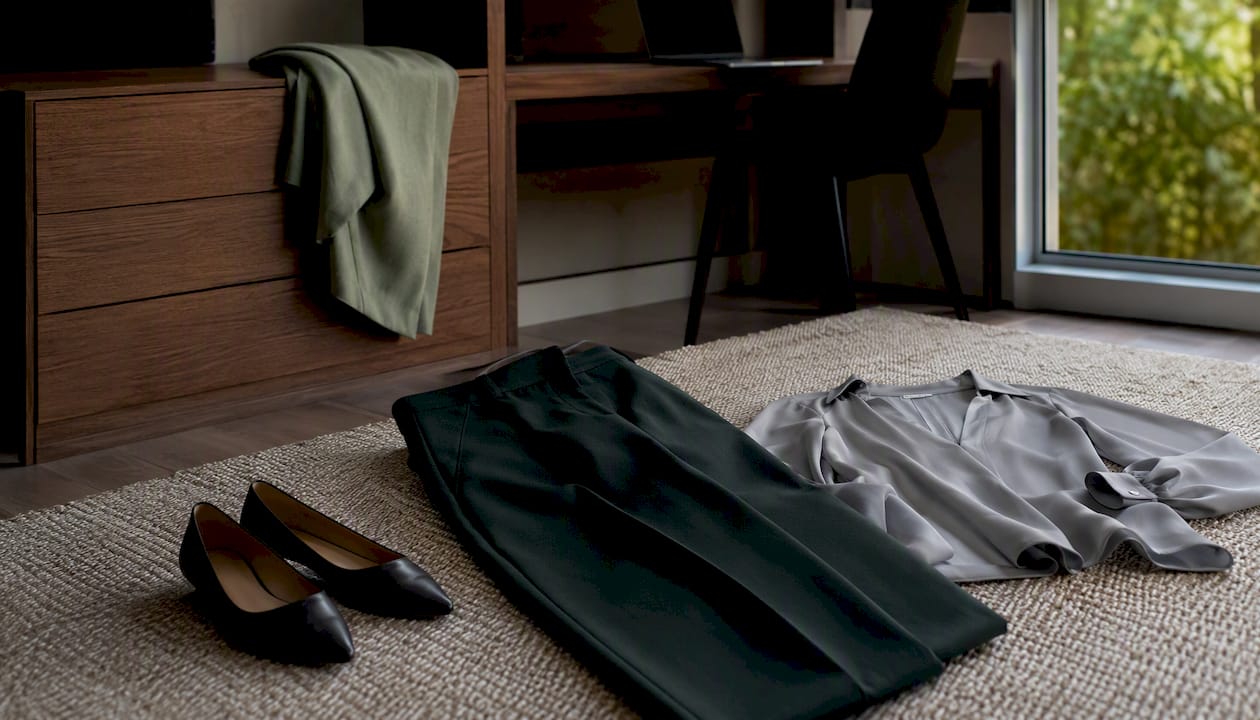
Remote creative (30 pieces): Dark slim jeans, wide-leg trousers, linen pants, six relaxed tops in a warm neutral palette, two oversized shirts, a denim jacket, a cardigan, one midi dress, white sneakers, ankle boots, a crossbody bag, and minimal accessories. The palette does the cohesion work.
Active-lifestyle weekend (28 pieces): Three athletic sets, two pairs of joggers, four casual tees, two flannels, a hoodie, one pair of dark jeans, trail shoes, clean white sneakers, a casual dress, a baseball cap, and a packable rain jacket. Functional and fast to dress.
Travel-focused compact capsule (18 pieces): Built on the 5-4-3-2-1 framework — five tops, four bottoms, three shoes, two dresses, one jacket — all in a tight two-color palette with one accent. Every piece fits in a carry-on.
Shopping guidelines when you need to fill gaps
Seasonal capsule anchors — the 5–8 non-negotiable pieces that underpin multiple outfits — are worth spending more on. Prioritize fit and fabric over brand. Natural fibers (cotton, wool, linen) tend to hold their shape and age better than synthetic blends in everyday wear.
Apply the pairs-with-three rule: a candidate piece should work with at least three items already in your capsule before you buy it. This single filter eliminates most impulse purchases. Think in cost-per-wear terms: a $180 blazer worn 60 times costs $3 per wear; a $40 top worn twice costs $20.
Step 3: Build outfit formulas and document them
Owning the right pieces is only half the system. The other half is knowing how to combine them quickly. Practical guides recommend building and photographing 10–15 go-to outfits; photos reveal proportion, fit, and real-life combinations more honestly than mirror checks.
Ten outfit formulas that cover most situations:
- Everyday casual: slim jeans + relaxed tee + white sneakers
- Elevated casual: dark jeans + fitted blouse + ankle boots + simple earrings
- Work standard: tailored trousers + button-down + loafers
- Work elevated: pencil skirt + structured blazer + block-heel pumps
- Smart casual: chinos + knit top + clean sneakers or loafers
- Weekend errand: joggers + oversized tee + trail shoes
- Casual dress day: midi dress + sandals or sneakers + crossbody bag
- Travel day: linen pants + breathable tee + slip-on shoes + packable jacket
- Evening out: dress or elevated trousers + heeled boot + statement earring
- Layered transition: jeans + tee + open button-down + ankle boots
Photo documentation workflow:
- Photograph each outfit on your body, not on a hanger. Flat lays miss proportion.
- Create a dedicated album on your phone labeled "Capsule Outfits."
- Add a short label to each photo: date, occasion, and any notes (e.g., "too warm for July").
- Review the album monthly to spot which formulas you skip and why.
Small swaps extend the range without adding pieces. Swap a belt, change a bag, add a scarf, or swap sneakers for boots. The same top-and-trouser combination reads differently in each version.
Step 4: Live in the capsule for 30–90 days and refine
Most sources recommend a testing window of 30–90 days before making permanent changes. That window surfaces real gaps and preferences that a one-week trial cannot.
- Track wear frequency. After each week, note which pieces you reached for and which you avoided. A piece worn zero times in 30 days is a signal worth taking seriously.
- Log missed occasions. Did you have an event and nothing felt right? Write down what you needed. That is a genuine gap, not a shopping impulse.
- Check comfort over time. A piece that felt fine in the store may prove uncomfortable after a full workday. Comfort data collected over weeks is more reliable than a fitting-room impression.
- Apply the swap-in rule. If you want to test a new piece, remove one from the active capsule first. Keep the removed piece in a trial box for 30 days before deciding to donate or return it.
- Run a maintenance check at 60 days. Inspect for pilling, loose buttons, worn soles, and fading. Repair what is worth repairing; replace what isn't. A capsule only works when every piece is in good condition.
Pro Tip: Keep a simple note on your phone titled "Capsule Log." One line per week: what you wore most, what you skipped, and what you wished you had. After 90 days, that log tells you exactly what to adjust.
Seasonal rotation follows the same logic. At the end of a season, store off-season pieces in labeled bins. Before bringing them back out, run the one-year rule again. If you didn't miss a stored piece during its season, it probably doesn't need to return.
Rules, systems, and how to adapt them to your life
No single system fits every person, but three frameworks are worth knowing because each solves a different problem.
Project 333 works best as a reset tool. If your closet has grown unwieldy and you want fast clarity, the 33-item, 3-month structure forces honest prioritization. Many people find that after one cycle, they understand their real wardrobe needs well enough to build a more personalized system.
Modular capsules suit people with genuinely distinct life contexts. A module is a mini-capsule for a specific context: a 10-piece work module, an 8-piece casual module, a 6-piece travel module. Pieces can overlap between modules, which keeps the total count manageable. This approach works well for people who shift between formal and casual environments within the same week.
The 5-4-3-2-1 method is a packing formula that doubles as a compact everyday capsule for people with simple routines or very limited storage.
A few practical rules that hold across all systems:
- Color palette first. Choose two to three neutrals and one accent. Every piece should work within that palette. This is the single rule that most affects outfit cohesion.
- Fit over trend. A well-fitted basic outperforms a trendy piece that doesn't suit your body or lifestyle.
- Flexibility over rigidity. The goal is a system that serves your life, not a constraint that creates stress. If 33 items is too few for your climate or dress codes, 40 is fine.
- Adapt for life changes. A new job, a new climate, a pregnancy, or a significant weight change all warrant a fresh audit. The capsule should evolve with you.
What to do with items you remove from your closet
Removing items is only useful if you have a clear plan for where they go. Indecision here is what causes boxes to sit in closets for years.
- Hold for 30–60 days first. Before any item leaves your home, put it in a labeled box with a date. If you don't reach for it during that window, you have your answer.
- Assess condition. Is it in good, sellable condition? Can it be repaired cheaply? Or is it worn out?
- Sell items in good condition. Platforms like Poshmark, ThredUp, and Depop are practical options for clothing in clean, wearable condition. Higher-end pieces may warrant a local consignment shop.
- Donate responsibly. Local shelters, Buy Nothing groups, and community clothing swaps often have more specific needs than large thrift chains. A quick search for local organizations in your area usually surfaces better options than dropping a bag at a generic donation bin.
- Repair before discarding. A tailor can replace a zipper, re-hem trousers, or take in a seam for $10–$25 in most U.S. cities. A piece you love but stopped wearing because of a minor fit issue is worth the investment.
- Discard responsibly. Items too worn to donate can often go to textile recycling programs. H&M, Patagonia, and some municipal recycling centers accept worn clothing for fiber recycling.
The decision box workflow reduces regret significantly. When you're unsure, box it and date it. The passage of time is a more reliable decision-maker than any in-the-moment feeling.
How a privacy-first digital wardrobe app supports your capsule
A digital wardrobe app turns the photo-documentation workflow into a searchable, organized system. The basic workflow is straightforward: photograph each piece, tag it by category and color, build outfit albums, and track wear frequency over time. Over weeks, the data surfaces gaps and redundancies that are hard to see otherwise.
The privacy dimension matters more than it might initially seem. Wardrobe photos are personal. They reveal your home environment, your body, your daily routines, and your location metadata. Cloud-based apps upload that data to external servers, where it may be used for advertising profiling, shared with third parties, or exposed in a breach.
On-device processing keeps all of that data local. No upload, no cloud dependency, no external data path. Searches run on your device, exports stay under your control, and the app functions fully offline.
When evaluating any wardrobe app, check for these features:
- Photo tagging by category, color, and occasion
- Outfit album creation and wear-count tracking
- Offline functionality with no required account
- Local backup and export options (CSV or photo export)
- Transparent privacy policy with no behavioral advertising
Obsidianridgelabs' Wove app is built on this on-device model. All core processing runs locally on your Apple device, which means your wardrobe photos and outfit data never leave your phone unless you choose to export them. For a deeper look at how on-device AI compares to cloud-based alternatives across wardrobe apps, the digital wardrobe app comparison at Obsidianridgelabs covers the key feature and privacy tradeoffs in detail.
What building a capsule actually teaches you
Three things tend to surprise people who go through this process carefully.
First, the audit is the hardest part, not the shopping. Most people expect the challenge to be finding the right pieces. The real friction is confronting how many items they already own but never wear, and making honest decisions about why. The one-year rule cuts through most of that hesitation cleanly.
Second, the pairs-with-three rule changes how you shop permanently. Once you internalize the habit of asking "what three things does this work with?" before buying, impulse purchases drop sharply. The rule is simple enough to apply in a store in 30 seconds, and it prevents the one-off buys that slowly erode capsule cohesion.
Third, a capsule wardrobe is not a finished project. It is a living system. Life changes — jobs, climates, relationships, body changes — and the capsule should change with them. The readers who get the most from this approach treat it as an ongoing practice, not a one-time reorganization. A 90-day review cycle, even a brief one, keeps the system honest.
The digital documentation piece is underused by most beginners. Photographing outfits feels unnecessary until you've done it for two months and can see, clearly, which formulas you actually wear and which ones you only thought you would. That data is worth more than any style advice.
Wove keeps your capsule organized without sharing your data
Every capsule wardrobe eventually needs a system for tracking what you own, what you wear, and what's missing. Wove, Obsidianridgelabs' on-device wardrobe app for Apple devices, handles that without sending your photos or style data to any external server.

You photograph your pieces, tag them by category and color, build outfit albums, and track wear frequency — all processed locally on your iPhone or iPad. When you want to find a gap in your capsule or plan outfits for a trip, the search runs on your device in seconds. No account required to start, no behavioral advertising, no cloud dependency.
Wove is available through the Apple App Store with one-time purchase and subscription options. If you're building or refining a capsule and want a private, reliable place to document it, visit the Wove app page to see current pricing and download options.
Sources
- How to Build a Capsule Wardrobe: 5 Steps
- How to Start a Capsule Wardrobe | Be More With Less
- How to Build a Capsule Wardrobe in 7 Steps (Wear-First Method) - Capsulee Wardrobe
- How to Create a Capsule Wardrobe | Wardrobe Oxygen